It’s that time of year of year, time to wake up the monsters and kick off the 2026 Gila monster breeding season! The cages have been cleaned and are ready to go, welcoming back home the inhabitants that have been in quiet winter slumber since December. The rise in temperature takes place over several weeks and continues into March as the Gilas go from complete cold and darkness to daily life of regular light and temperature changes.
Wakey wakey, mice and eggy’s (or something like that..)
Last year was our best year not only in success of eggs hatched, but also producing some very uniquely patterned babies. Our hyper pink line produced one baby which is already showing its insanely pink coloration, the aberrant line is producing some amazingly interesting patterns.
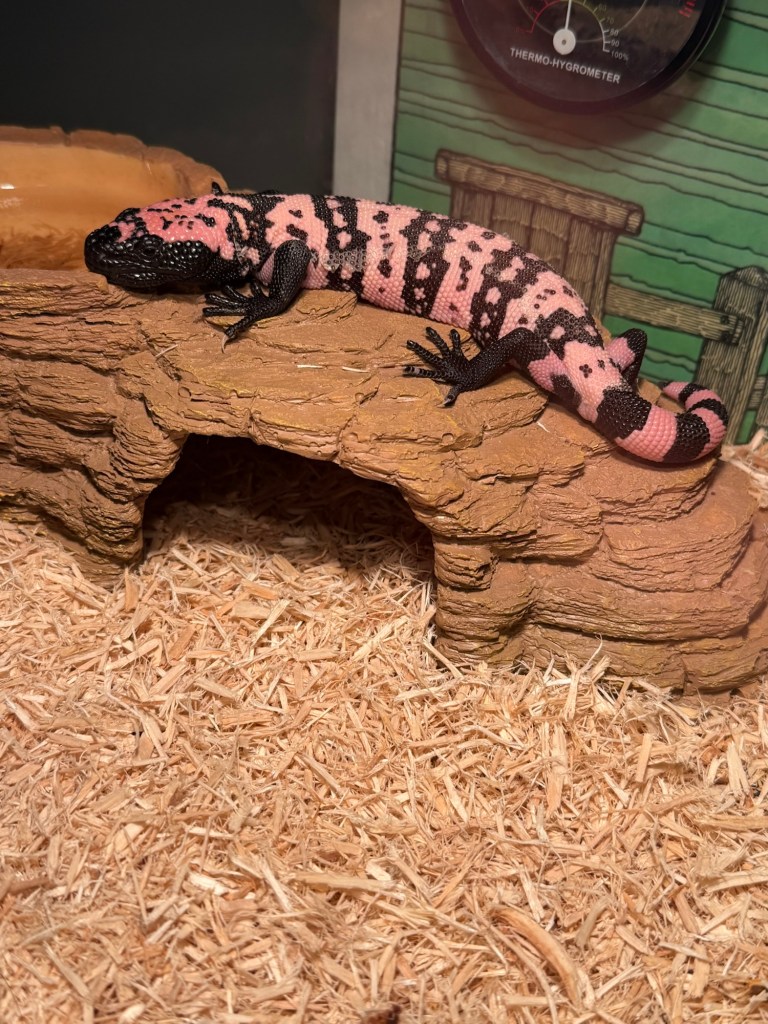
So pink at only five months old! Photo by ST who is shaming me with these photos for selling this Gila:)
As with every season, hopes and dreams abound thinking of the pairings and who will produce what. Regardless it’s a win, just working with Gilas and producing babies is enough for me. I’ve already started reviewing my notes from previous years and re-reading my mentor Dr. Mark Seward’s “Gila Monster Propagation” and other books and articles to see if I can glean anything new (which I always do).
One of our 2025 aberrant baby Gilas.Our 2024 holdback is getting more orange everyday!
One thing is for certain, it will be another amazing season so stay tuned for updates max we embark on a new adventure in Gila monster! The 2026 waitlist is getting pretty beefy, if you want to reserve a Gila do so now! This is especially true if you are looking for a hyper pink or “Gators” orange, or the very limited aberrant line!
The pairs have been paired and soon we get to see how things went. I’ve been doing this long enough not to expect miracles, but I must admit to being a little more than excited about having six females, including our axanthic, potentially laying eggs this year. It is always a bit like Christmas morning when you’re a kid waiting for Gila monster eggs, you’re not quite sure what you’re going to get, but you hope it will be everything you’ve dreamed of all year. All the planning, cooling, feeding, and pairing comes to fruition or failure now.
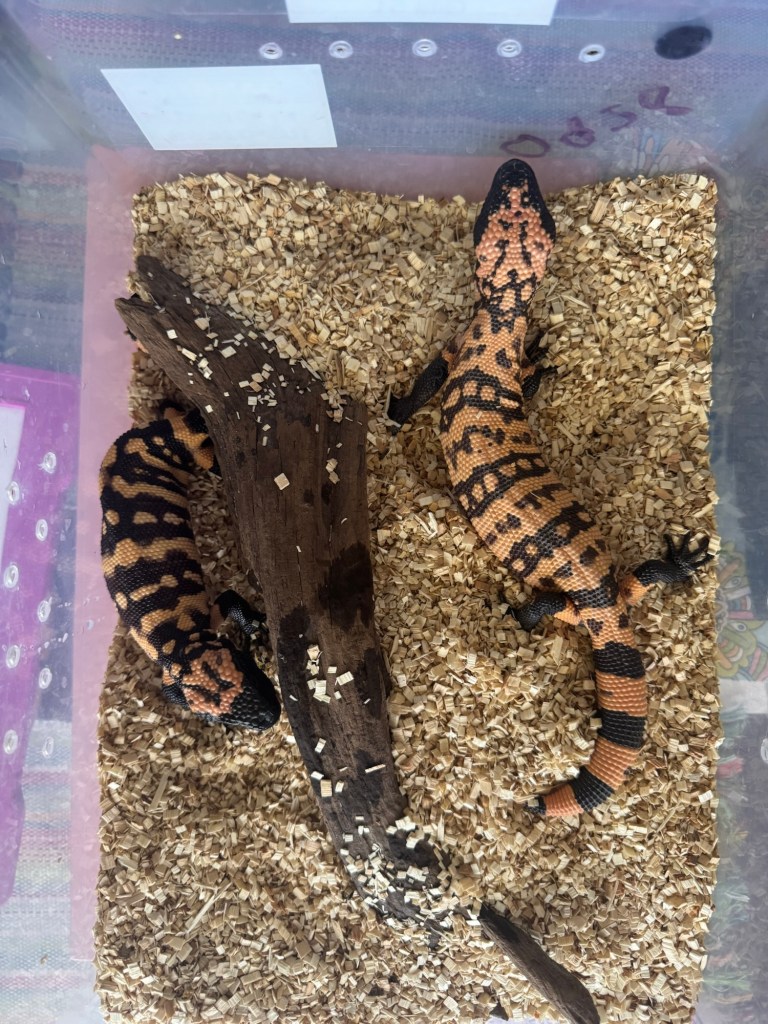
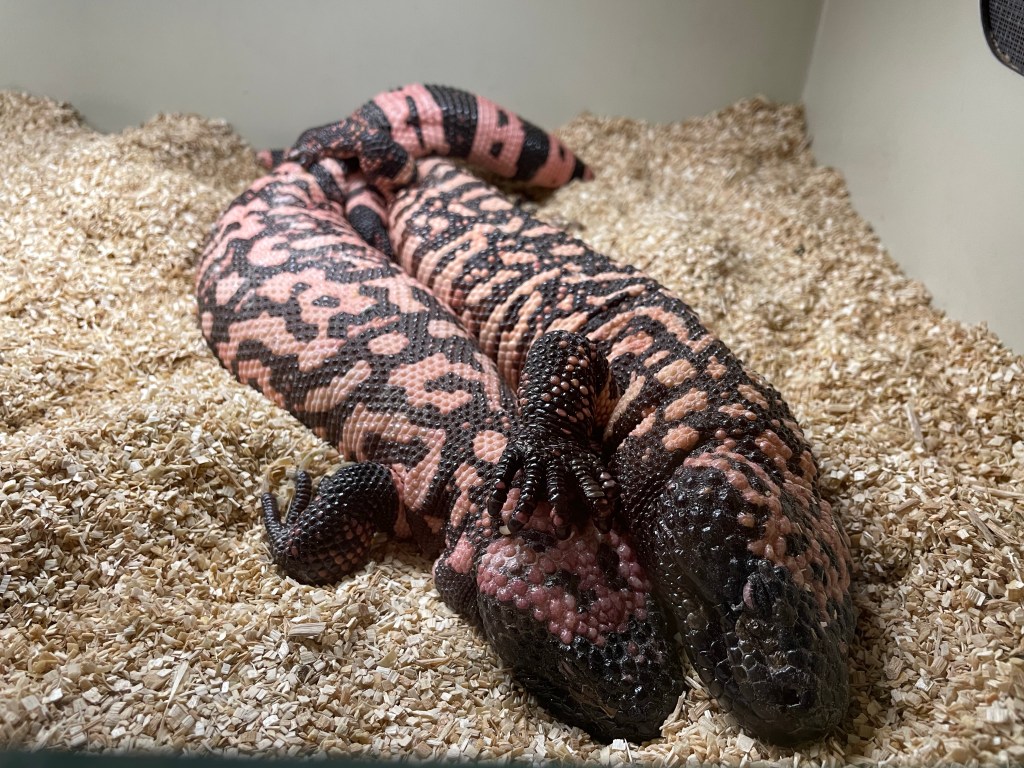
The Gilas get very close throughout the season.
Setting up the pairs in hopes of achieving specific traits such as high pink or orange, reduced or abnormal patterns, or axanthic, is meticulously planned based on babies that have been produced here. I am in touch with many of the folks that have purchased Gilas from us here at Goatsby’s Place and track how they grow to try and replicate these traits. The axanthic line, originally from Seward’s project, is very exciting and we hope to have some 100% hets this year from that pairing.
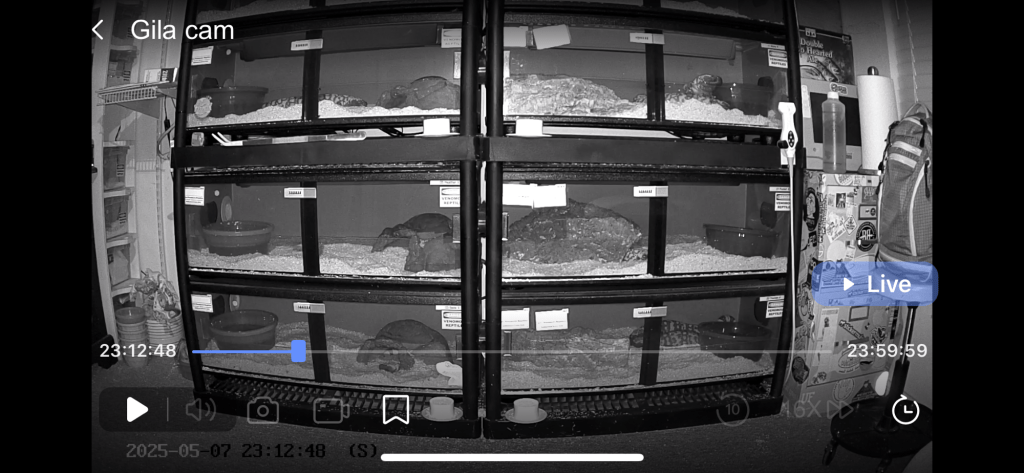
Smile you’re on Candid Camera! Pairs are watched and recorded throughout the day and night for mating activity.
After oviposition the long wait begins. It’s been common for eggs that will not make it to term to expire within the first 30 days after being laid, though they can go bad at any time really. Never count your Gilas before they hatch is a good analogy! There’s a lot of hurry up wait at this point but it’s all part of the process in breeding Gila monsters.
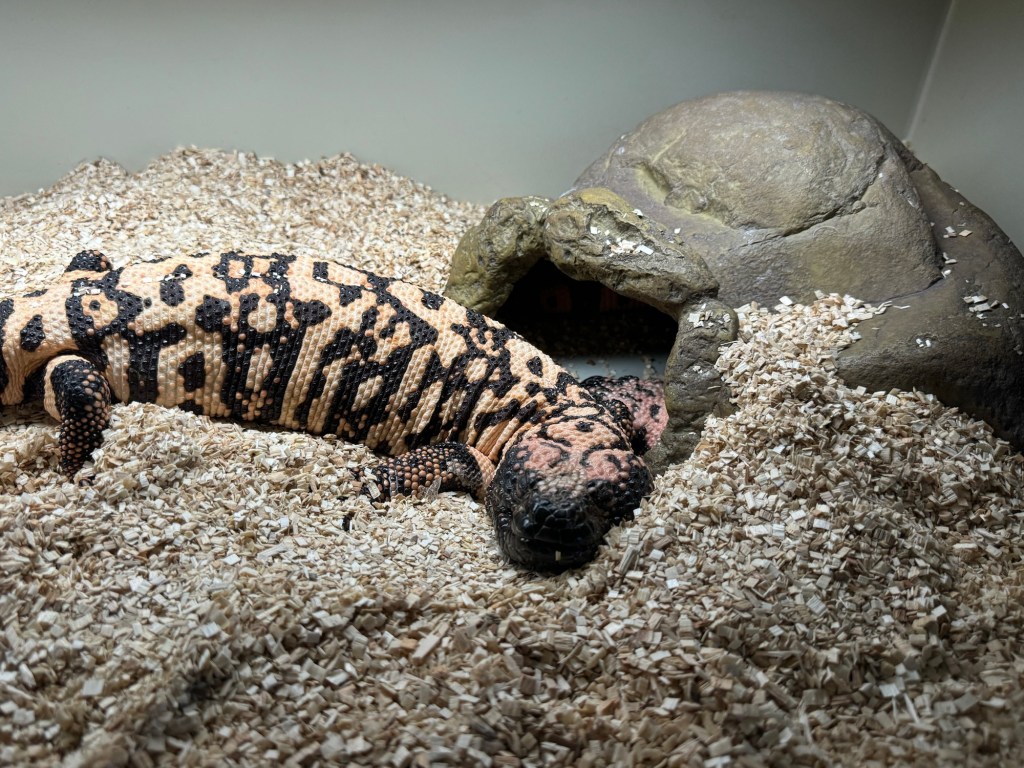
Winnie the axanthic Gila laying out of her shelter.
Every year starts out with hope and we are thankful that it has ended with baby Gila monsters for the past six years. Some eggs are not fertile or make it to full term, but as long a a baby Gila pips its head out of the egg in the fall it is all worth it!
Loading screen from The Bard’s Tale (one of the first computer RPG’s from 1985)
The Gila monsters at Goatsby’s Place are waking up after the long winter’s nap, officially kicking off the 2025 Gila monster breeding season!
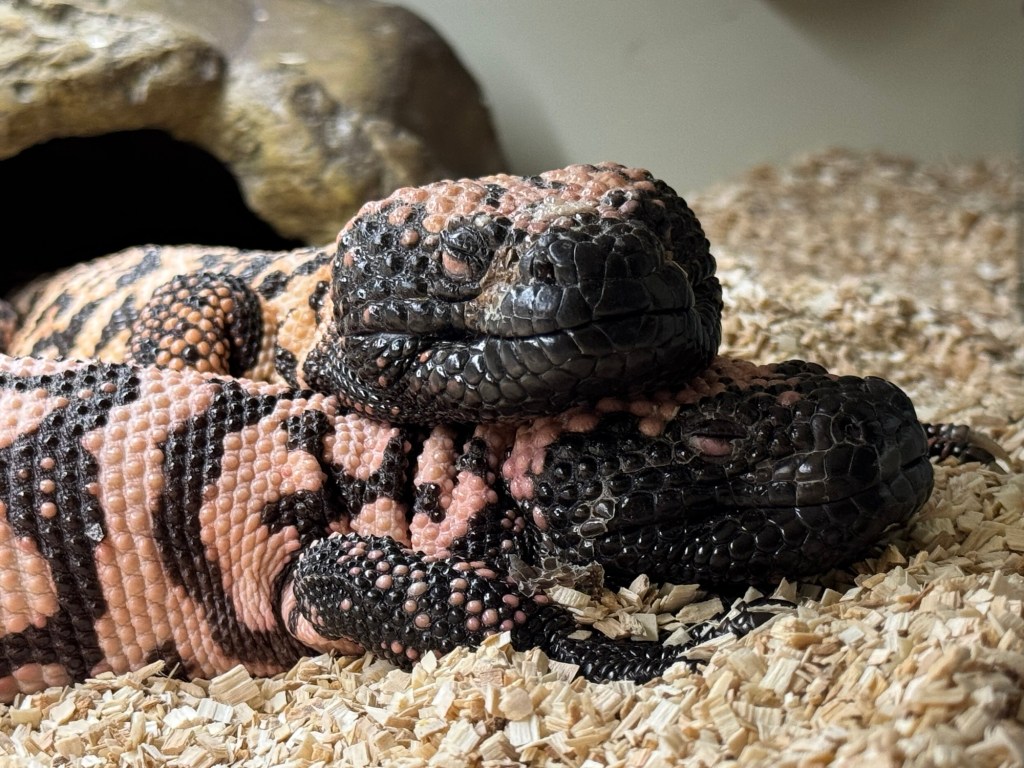
One of our newer additions is waking up after being brumated since December. It takes them a week or so to really get moving again.
Every year starts off with a lot of hope, but this year is even more hopeful as we have a lot of exciting things going on this season. We have a pair of beautiful banded Gilas that are new to the mix, and two females that bred for the first time last year (one is Winnie the Seward axanthic Gila, the other is the stunning pink banded Gila Lucy), and our stalwart females Heather and Belle will be in the mix again this year as well. As the Gilas wakey wakey I will start ultrasounds this weekend and feeding begins next week. First will be small meals of single adult mice, and once they defecate regular feedings will begin.
Lucy was not bred last year to build her weight and strength to successfully breed this year.
Stay tuned for more updates and photos, and if you wish to get on our list for 2025 please do so earlier than later. We have a healthy list already (many are repeat customers which is amazing!) and as a smaller-scale breeder, babies will be limited!
This never gets old. Say hi to the world’s youngest Gila monster!
As our Gilas hatch those on the waitlist will be contacted in the order joined. We only had four eggs this year, so availability is very limited but let us know if you want to get in the list for 2025. Or, just reach out to talk Gilas!
While all was quiet on the blog and social media posts, we have been working diligently behind the scenes with our monsters, and are kicking off our 2024 Gila monster breeding season!
Misty, a high-orange female Gila monster produced here in 2019, will be bred with an unrelated bloodlines this year.
While every year is certainly exciting, 2024 is off the charts for us here at Goatsby’s Place! Besides the fact that our Seward-line axanthic female will be breeding for the first time, we also have two of our own Gilas also breeding for the first time! We will have a total of four females breeding this year, and four males to mate them with (a 1:1 ratio, which is preferred).
Winifred is our Seward-line axanthic female Gila monster.
As the season starts anew, it’s a time to reflect on past year’s successes and failures. I re-read my notes and chat with other breeders and try to see how we can do things better. This year’s focus will again be nesting in hopes of having more viable eggs laid on time. I’ve come up with a new nesting strategies and will be sure to share that here once we have it worked out. We’d also like to get more proficient with the ultrasound and be able to time ovulation and oviposition with greater accuracy this year.
A sight we hope to see mid-April!We monitor growing follicles and testes on our Gila monster by ultrasound. This helps us to keep an eye on reproductive development and when the highest chance of successful pairings are. Male testes also change throughout the year and need to be monitored.
Besides having the fortune to live with Gila monsters, its both profound and humbling to enter each year with these amazing reptiles and learn more about them. Having produced Gilas each year just feeds my love for them, and I’m sure this year will be no exception!
Gilas just wanna have fun!
Stay tuned for some exciting things happening at Goatsby’s Place this year, new videos, lots of photos, and of course more Gila monsters! If you’re interested in getting on our rapidly growing waitlist please email us today. And if you have any questions or there is something you’d like to see on an upcoming video please let us know. Thanks for stoping by!
Hey Monster Squad! It’s been way too long since I last sent an update out which is disappointing as so much has happened since the last post. As with all Gila monster breeding seasons, this one was full of surprises and a lot of lessons to be learned.
Caught in the act.Well, we know what this is..Locked up at night.
First, during pairing and copulating we attempted a 1.1 ratio for breeding pairs which we hoped would increase success. Two of our previously bred females were seen copulating at least five times, but the new girl we got last year was only seen once. Eggs seem to be maturing well as monitored on ultrasound, except for the new female which only had two eggs (the other two females had greater than five eggs from what we could see). By the time egg laying came about in June this is where things change and deficiencies in our program were found. our two long-term females produce 13 eggs between the two of them, and the new girl produced two.
Egg forming from follicle as seen by ultrasound. Egg at a later stage, the shell now visible on ultrasound. Momma monster made a nest for her tightly buried eggs and guarded the nest for over two weeks!
Unfortunately only four of the 15 eggs survived of the whole group to date. One was actually eaten by it mother! This was a severe disappointment but valuable lessons were learned. First, the new female was under condition and not ready to be bred but she had enough weight and we thought she would be ready, she was not. Second our egg-laying protocol needs to be revised as it appears our girls are not comfortable laying eggs in their current egg boxes, which at this time are the entire cage turned into an egg laying nest with dark tint over the glass to provide privacy. Unfortunately this is not enough and we are going to try something entirely new next year fingers crossed!
Inside the nest above, six Gila monster eggs!Bad eggs and good eggs, wish I had Willy Wonka’s machine to save some time.
As we approach the end of October we have four eggs still in the running. Four out of 15 is not a good ratio but some success is certainly better than none at all! It’s interesting that most eggs go bad within the first 30 days of laying, which says to me that our incubation protocol technique is working. Of course mid and late term and losses have happened but generally most eggs even fertile they are doomed will go bad within the first 30 days. These days I’m checking the incubator daily opening to egg boxes for fresh air as the humidity and temperature continue to remain stable throughout the week incubation period. We are super excited for the birth of our baby Gila monsters – each time I truly feel like a kid during Christmas opening the big gift center left under the tree! As soon as the babies are out we will post pictures and contact those on the waitlist in the order that they joined (Allen you’re up first!).
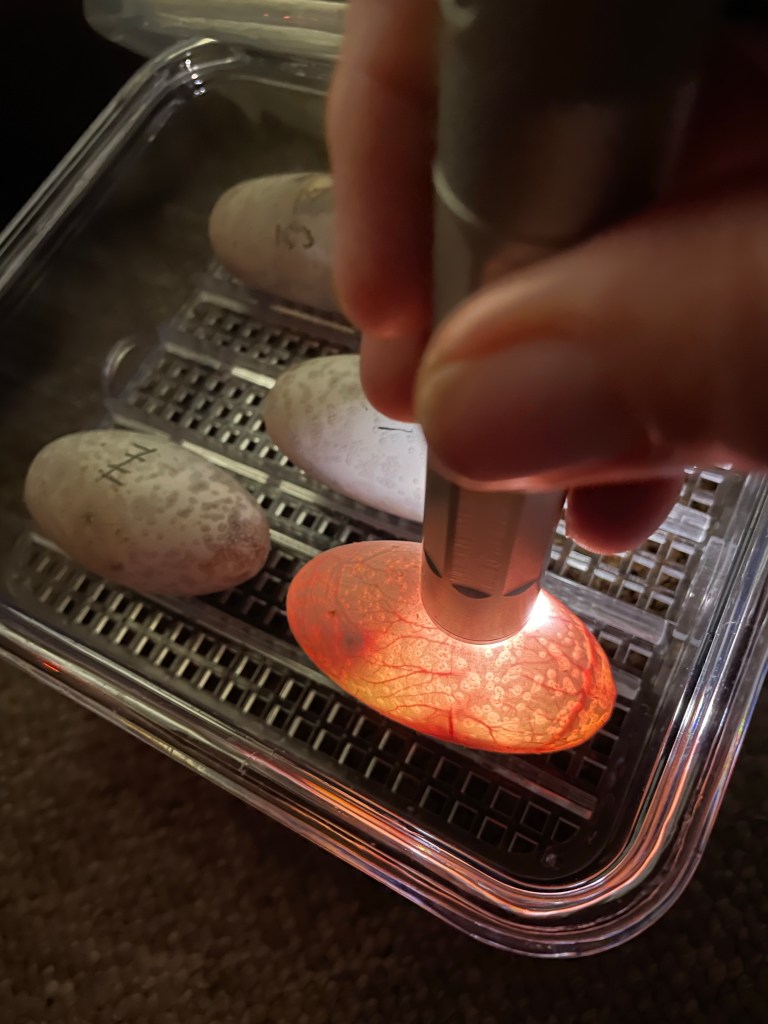
Late-season candling of a viable egg showing nicely growing veins.
So as we wrap up our 2022 Gila monster breeding season and get our monsters ready for the Big Chill (hibernation, not the movie), we look forward to an amazing 2023 breeding season. One of our 2019 females produced here is growing follicles as shown by ultrasound and will be attempted to be bred next year. We are also very excited to have our axanthic Gila monster Winnie up to condition and ready to breed next year. This is a very, very exciting project for us as few of these morph are being bred throughout the world. We are also excited to put into motion the lessons we learned in this and past seasons to improve our success and to see more amazing baby Gila monsters born into this world, because what world isn’t better with more Gila monsters in it?
Winnie, our axthanic Gila, looking to be in good condition
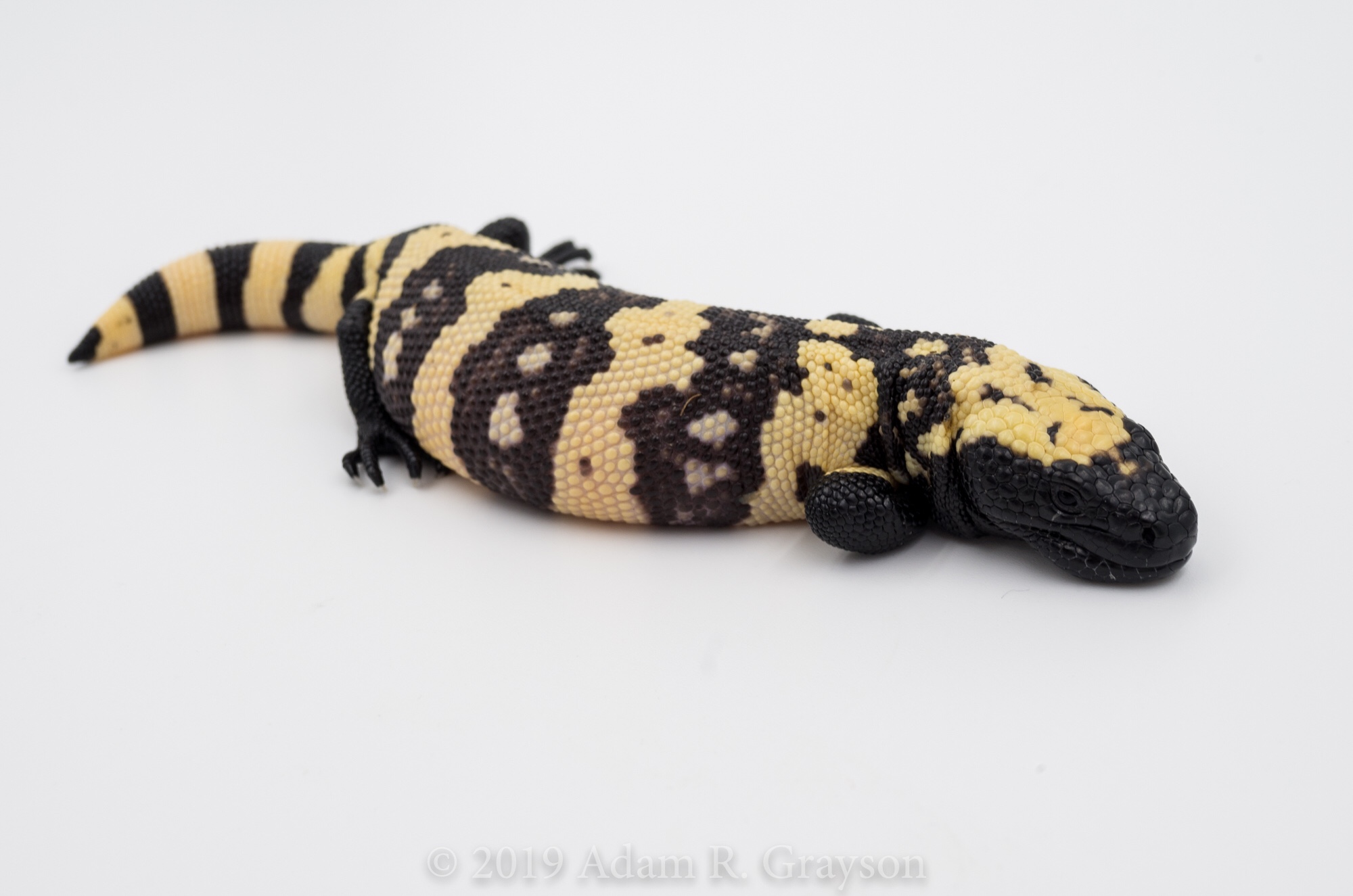
This photo shows offspring produced here over a three-year period; 2019-2020-2021. They really start to chunk out after the second year, but still have some growing to do!
The 2021 baby Gila monsters are all out and settling in here at Goatsby’s Place! We are very proud of our beautiful baby monsters, and feel blessed to have been successful again this year. While most are spoken for, we may have a few available for new homes. Please email us if interested, or to get on the list for 2022.
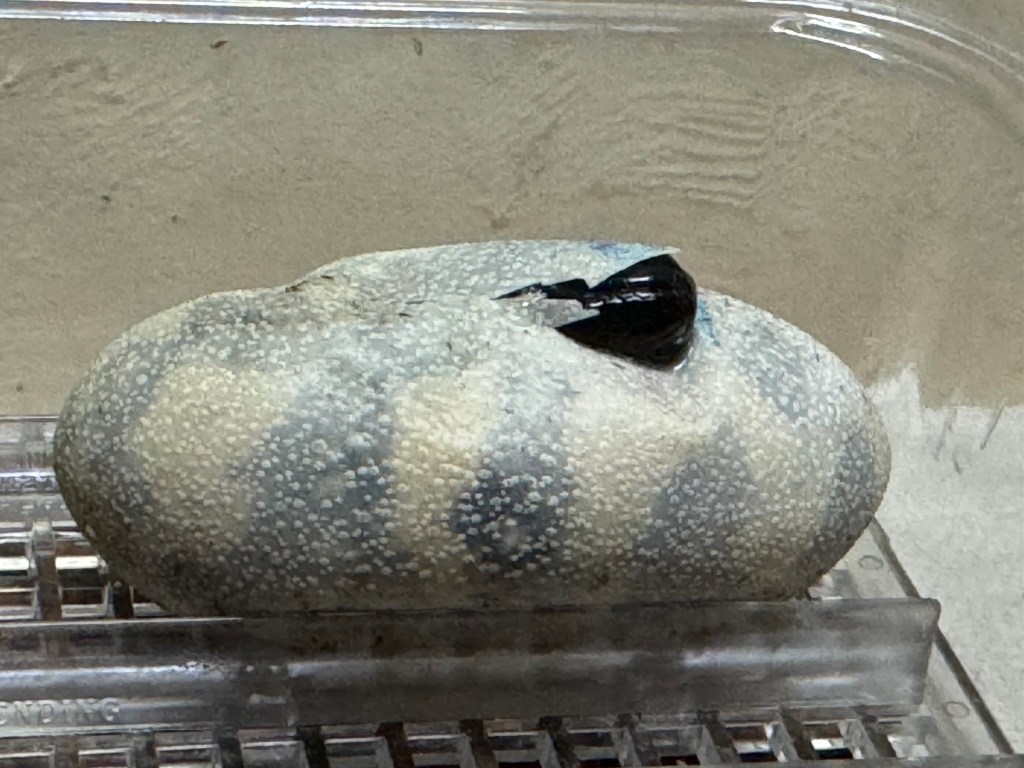
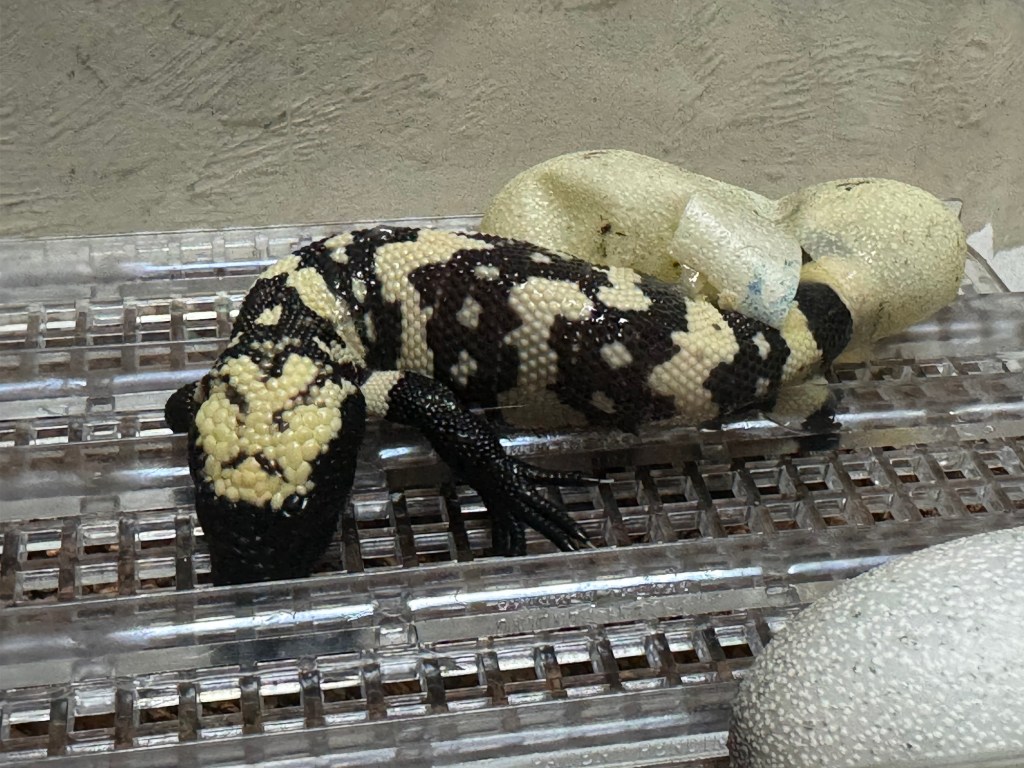
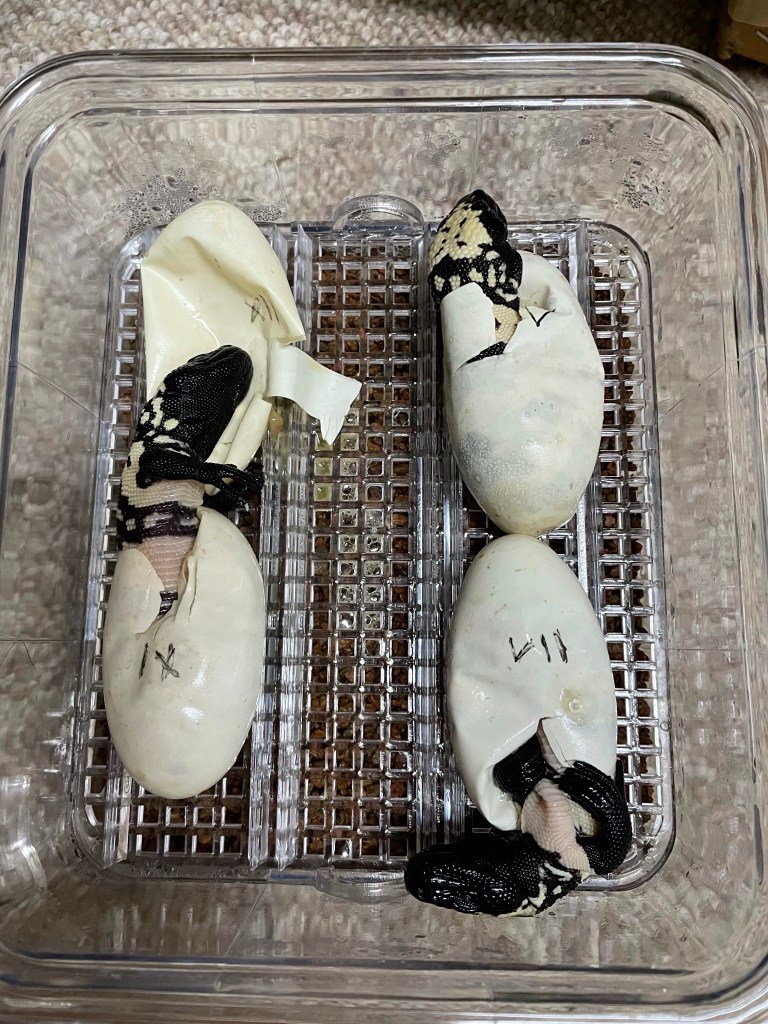
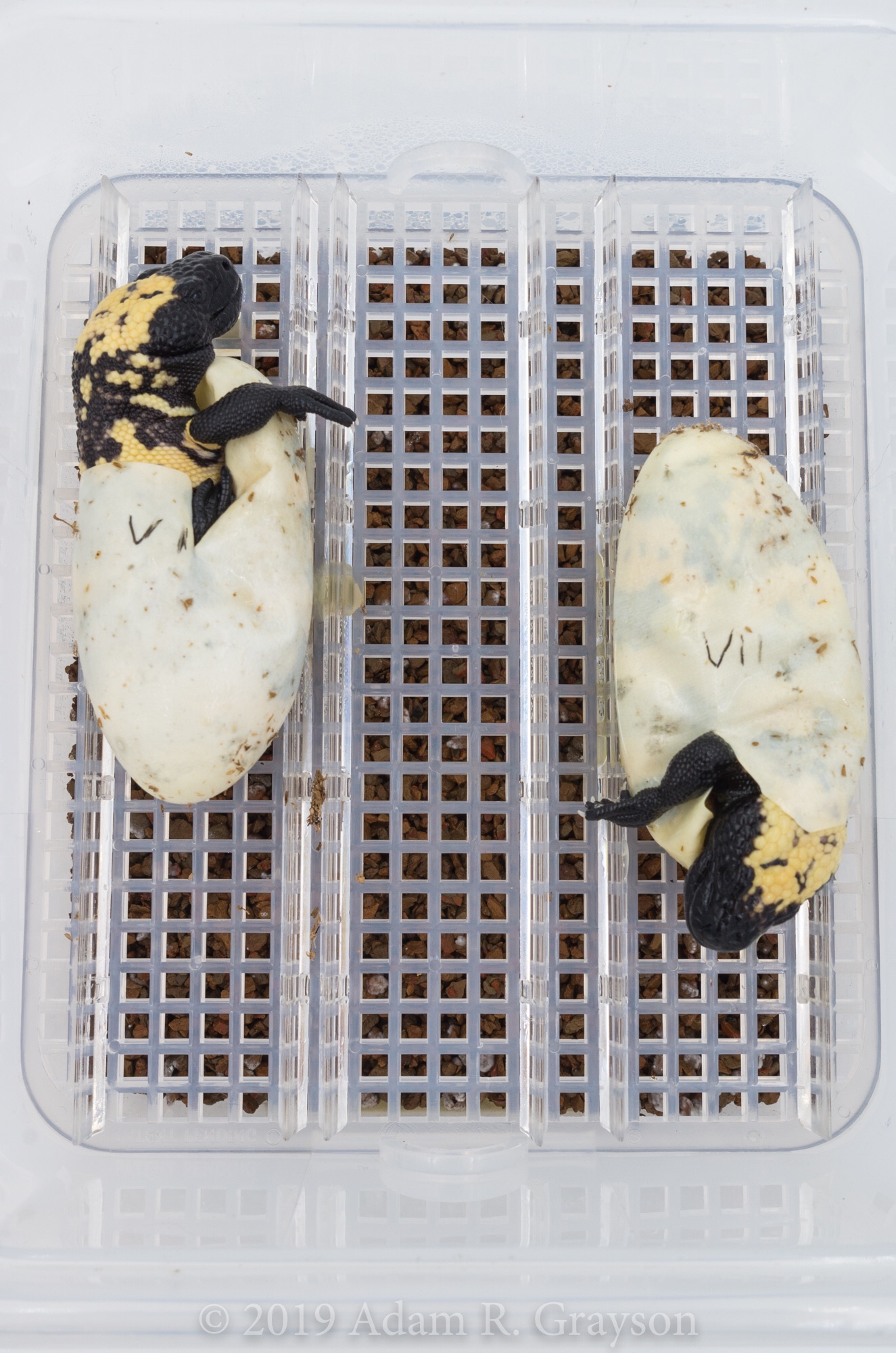
So, almost after all hope was lost on Day 153 the first Gila monster egg pipped from its leathery shell! Egg 02 at first cut a small slit and then a few more and over the next two days began to emerge from the egg. At first the baby Gila stuck its nose out, then it’s head, then half its body, and finally the entire body. It appears that hatching is a labor-intensive process as there are long pauses between progressive stages and also seems to be a good way of ensuring all the contents of the egg are consumed before leaving the egg. Over the ensuing days this process was (and currently is for two more lizards) repeated over and over, with Gilas emerging from their shell about two or so full days from pip to full emergence. Once the contents are completely devoured the neonate Gila monster leaves its shell and begins to wander the egg box. I witnessed one Gila that was out actually eating the egg yolk of another just coming out of its shell! Greedy bastard.
Once fully emerged and climbing around, the little monsters are pulled from the egg box, photographed, weighed, and set up solo in an 18 quart Sterelite box with paper towels as bedding and small water dish. The paper towel bedding serves as a clean substrate while the umbilical wound heals and the first few meals are eaten and passed through to make sure everything is going well. I will attempt the first feeding next week after the yolk has been fully digested and look forward to raising the babies from there!
I will be posting updates on the neonates growth, as well as some thoughts and insights on my first season captive breeding Gila monsters. Some reviews of the equipment I used is also likely in order as these items played an important role in my success. Whew, what an amazing season! The process has been fun, though frustrating and worrisome at times, and I look forward to greater success next year with these amazing reptiles!

















 Goatsby's Place