The 2021 baby Gila monsters are all out and settling in here at Goatsby’s Place! We are very proud of our beautiful baby monsters, and feel blessed to have been successful again this year. While most are spoken for, we may have a few available for new homes. Please email us if interested, or to get on the list for 2022.
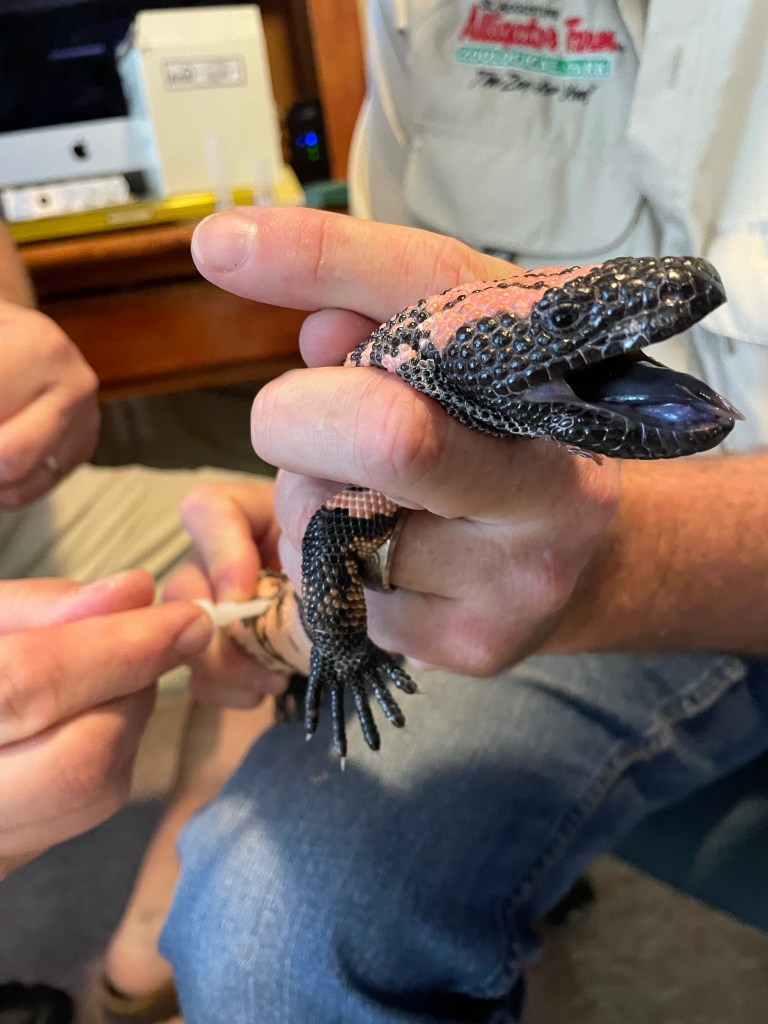
PIT (passive integrated transponder) microchip tags are certainly not new to the pet industry, being used extensively on cats and dogs to help lost animals find their way home. Taking this application a step further, some reptile owners PIT tag their herps to help keep track of animals in their collection or to identify those produced by a certain breeder. Until recently I haven’t given much thought to putting these microchips into my Gilas but a recent incident convinced me otherwise.
Someone on an Internet forum claimed to be selling one of my Gilas, but they didn’t have the “Certificate of Captive Birth“ that I provide with each Gila born here, and the person selling the animal was not registered on my list. I take this very seriously as there are folks selling wild-caught animals as captive-bred using well known breeders names and credentials. After a short investigation, it was found that the Gila was not one of mine but someone was using my name to sell a Gila of unknown origin (I cannot say for sure if it was wild-caught, but the circumstances around this sale were very suspicious). To help verify my Gilas in the future, I decided to look into PIT tagging my lizards.
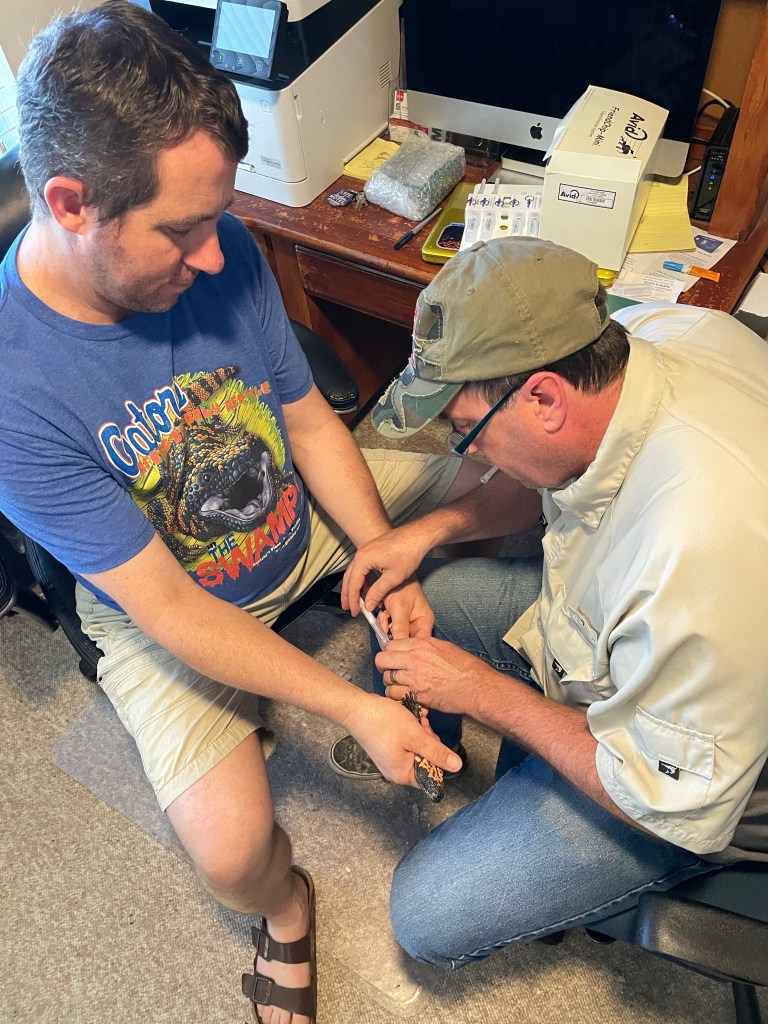
After doing some research and speaking with my friend John who is very knowledgeable in both Gilas and PIT tags, it seemed this would be a good way to go in ensuring my Gilas could be easily identified within my group and to those that purchase from me.
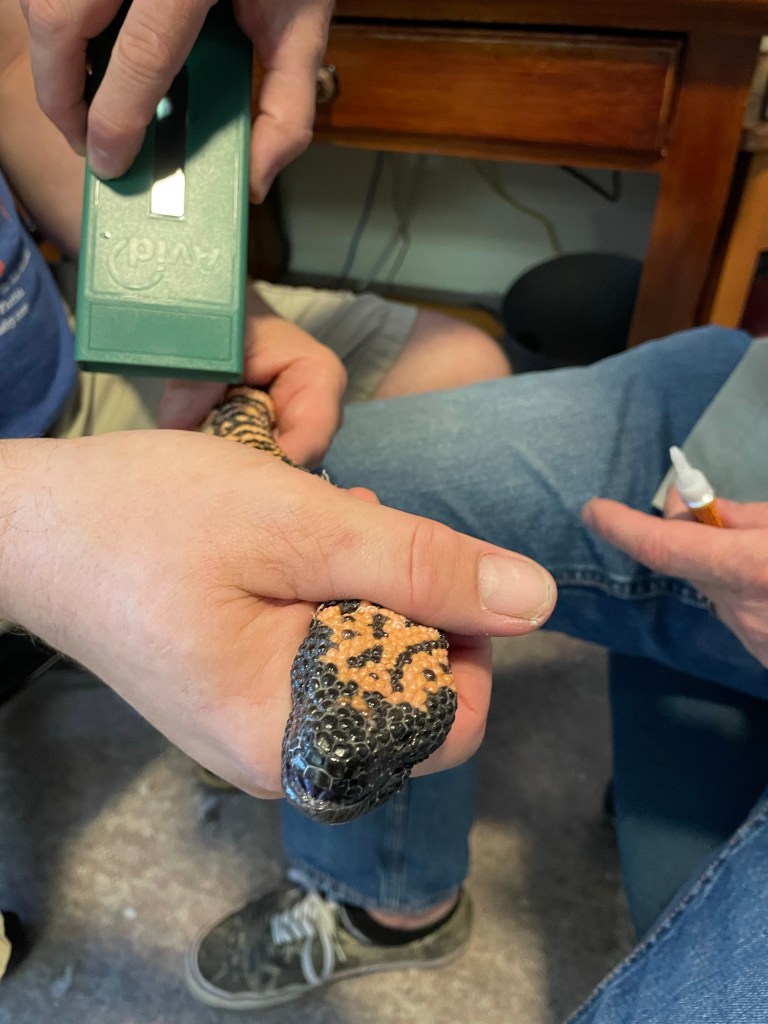
Overall, the procedure is simple and can be done at home with the help of an experienced vet tech or if you are lucky enough to have a good friend knowledgeable in such things (thanks John!), otherwise inquire with your herp vet about the procedure. The health and safety of the animal is always paramount so please don’t take shortcuts on this or any matter concerning your Gilas. I was able to do this at home because I had an experienced friend but would not hesitate to take my Gila monsters to the vet to get the PIT tag installed safely.
After installing the PIT tag, it was checked with a scanner to be sure it didn’t come out. Handling Gilas is always a risky proposition, be sure to put the safety of yourself and those working with you first!
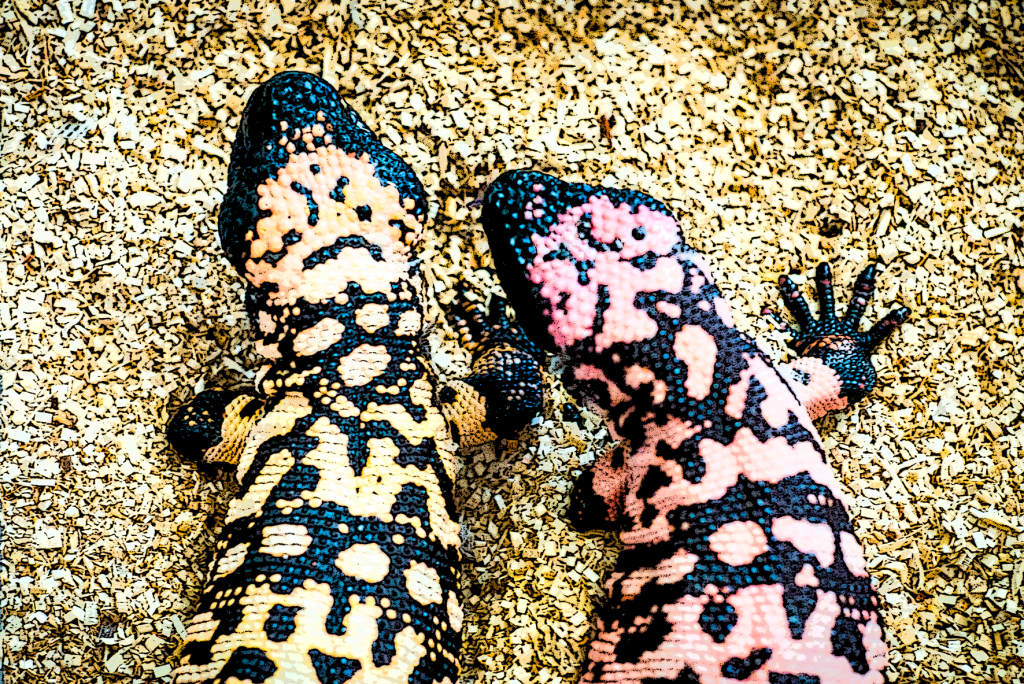
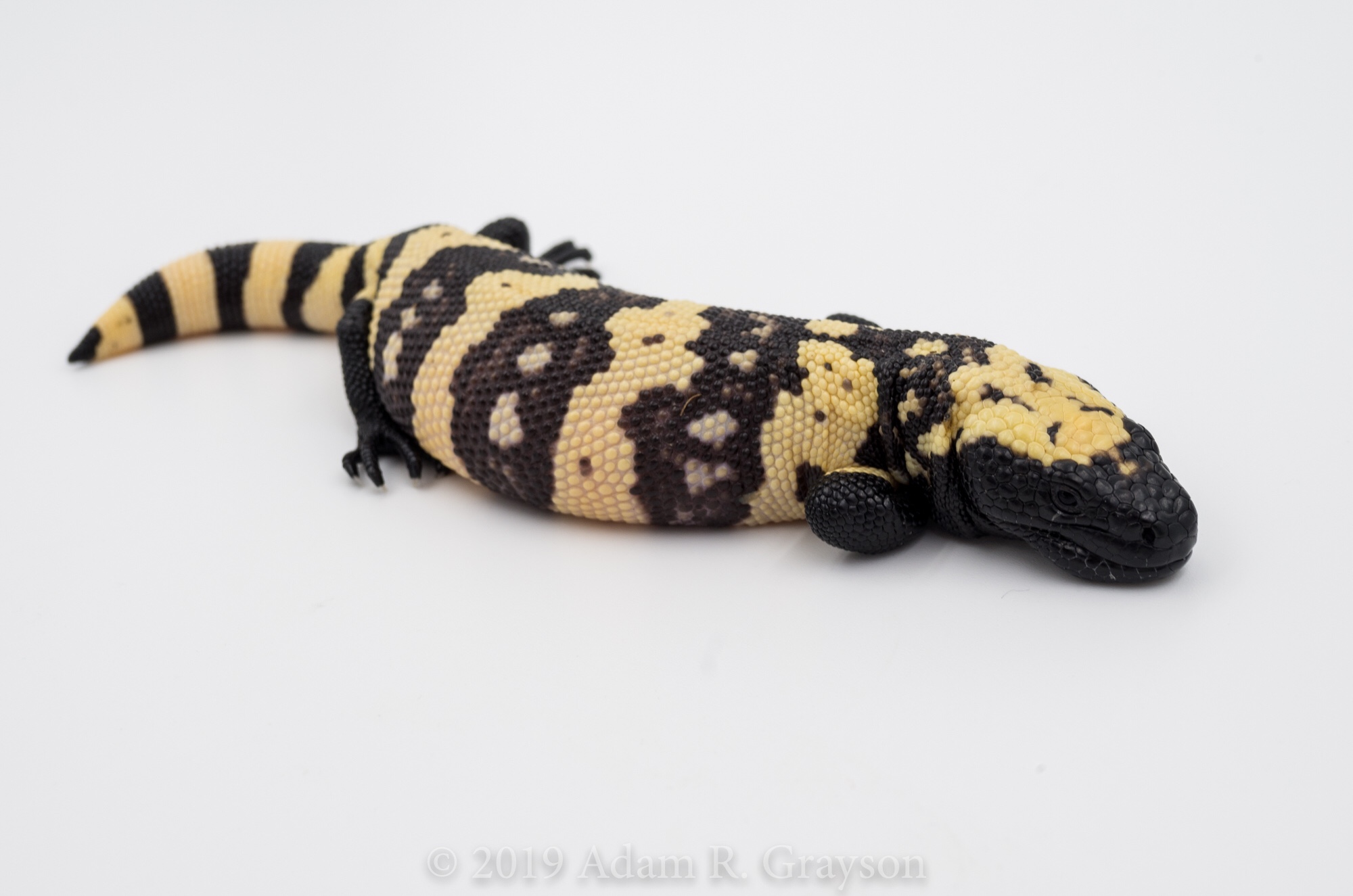
Which one is the boy and which is the girl? Guess first, then answer below.
My 2020 Gila monster season is off and running. After reviewing my data and re-reading my Gila books, I was going to wait until after April 1 this year to pair the Gilas as that is when the magic happened (and seems to be for others as well). With the Shelter-in-Place order in full effect I got bored and but them together last weekend, and guess what? No activity yet. What I have found interesting is that the Gilas seem to remember each other from last year and there was no fighting between the pairs (females bit males for being too pushy). This year they are much more chill, and are spending time together the hide boxes. I have been checking in at night to see what is going on and while both Gilas are active, copulation has not yet been observed. Being a Nervous Nelly, I am concerned that they will not breed this year but will hold my real worry for late April
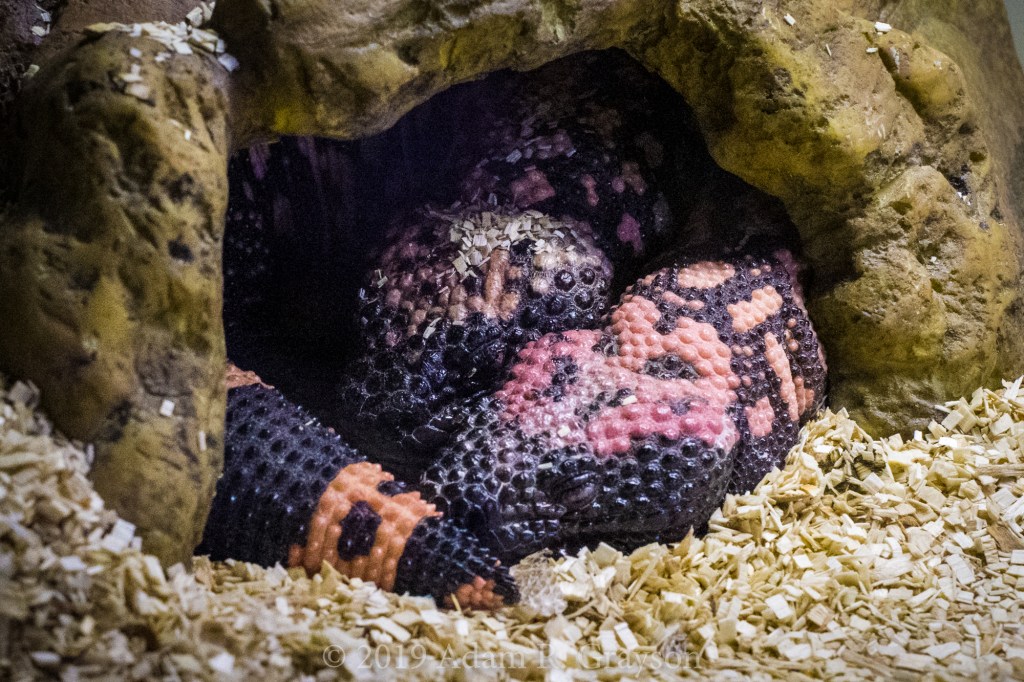
Belle & Pink Floyd (banded Gila monsters) resting sweetly in their hide cave
To me, the real question is could Gila monsters mate for life? I’ve read that in the wild males go back to the same shelters where they have previously copulated and in my observations females certainly do prefer some males over others. The way they rest together and spend time with each other makes this is an interesting avenue to explore. Some breeders swap different females in male cages and have great success, but I am going to try leaving known pairs together to see how things go. I can see why having one pair of Gilas could be difficult to breed and that groups (3.3 or greater) are suggested.
Winston & Heather (reticulated Gila monsters) snooze the day away
As with all things, time will tell. New observations, and hopefully some activity, will be reported here. Stay tuned..
With the babies I’ve held back are growing like weeds and coloring up beautifully, I’ve taken the adults out of brumation and am warming them up and will be feeding them their first meal soon. I’m both excited and nervous as to how this season will turn out. Will all the eggs paid be fertile? Will all the fertile eggs go to term? An educated guess says no to both but if improvements are made I am moving in the right direction.
I’ll be doing some new things this year. First, I’ll be pairing straight reticulated with reticulated, and banded with banded. Also, instead of leaving switching males between cages I will keep one male with one female for the duration of the breeding season. The females do seem to have preferences, and hopefully they still lie each other this year. I am waiting until the last week of March to start pairing as last year the females were not receptive and often attacked and bit the unrelenting males so it would be nice to avoid this drama and potential injury. I’ll keep everyone posted on the progress and of any successes and failures on my second year of breeding these amazing Gila monsters!
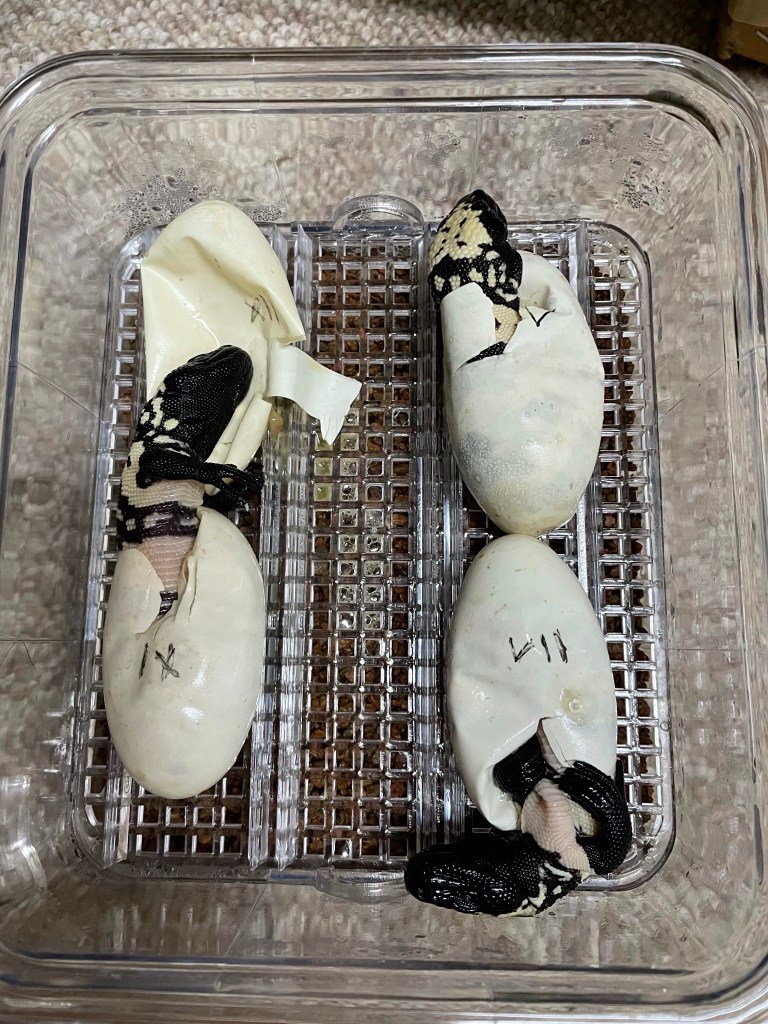
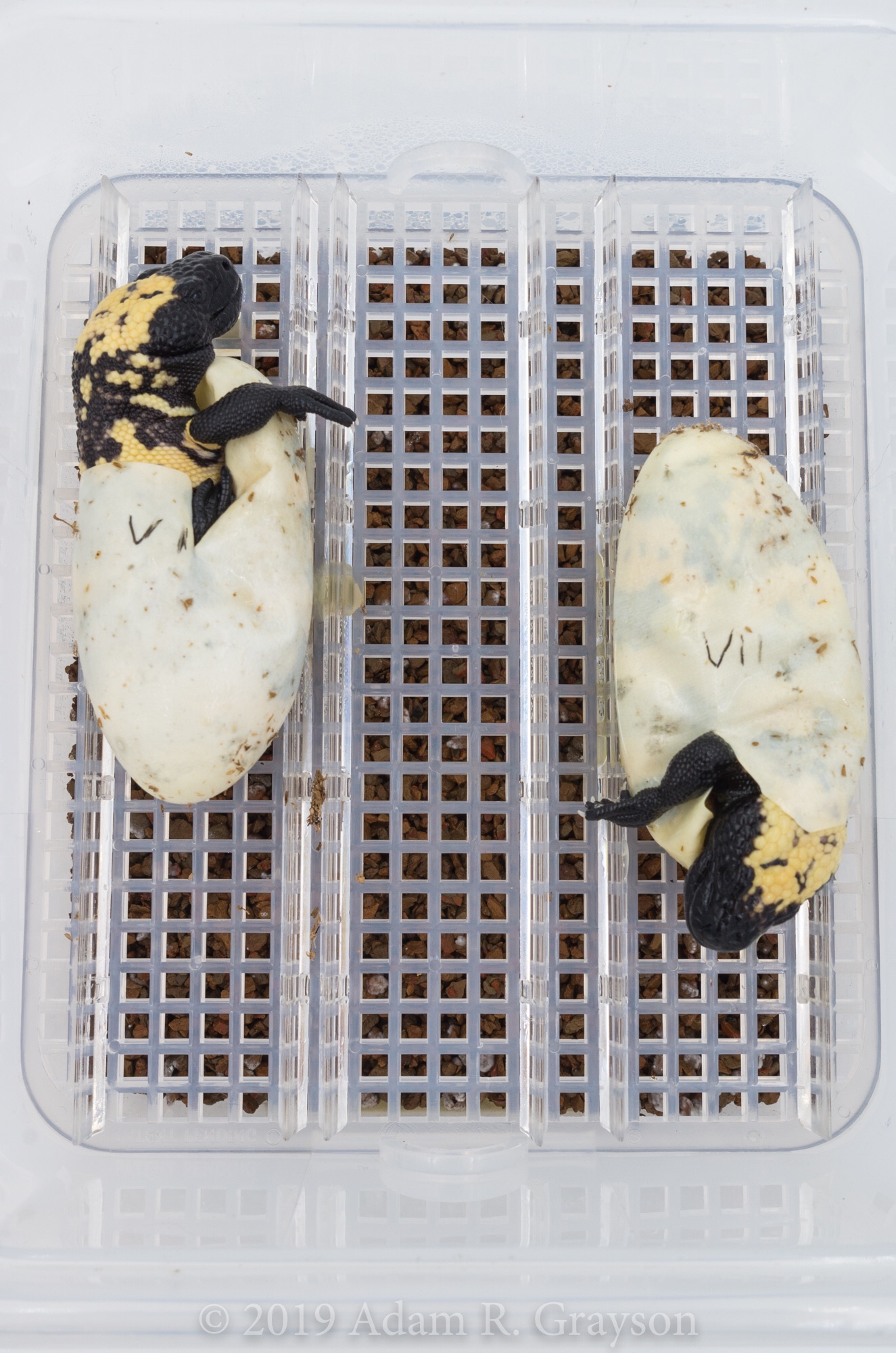
So, almost after all hope was lost on Day 153 the first Gila monster egg pipped from its leathery shell! Egg 02 at first cut a small slit and then a few more and over the next two days began to emerge from the egg. At first the baby Gila stuck its nose out, then it’s head, then half its body, and finally the entire body. It appears that hatching is a labor-intensive process as there are long pauses between progressive stages and also seems to be a good way of ensuring all the contents of the egg are consumed before leaving the egg. Over the ensuing days this process was (and currently is for two more lizards) repeated over and over, with Gilas emerging from their shell about two or so full days from pip to full emergence. Once the contents are completely devoured the neonate Gila monster leaves its shell and begins to wander the egg box. I witnessed one Gila that was out actually eating the egg yolk of another just coming out of its shell! Greedy bastard.
Once fully emerged and climbing around, the little monsters are pulled from the egg box, photographed, weighed, and set up solo in an 18 quart Sterelite box with paper towels as bedding and small water dish. The paper towel bedding serves as a clean substrate while the umbilical wound heals and the first few meals are eaten and passed through to make sure everything is going well. I will attempt the first feeding next week after the yolk has been fully digested and look forward to raising the babies from there!
I will be posting updates on the neonates growth, as well as some thoughts and insights on my first season captive breeding Gila monsters. Some reviews of the equipment I used is also likely in order as these items played an important role in my success. Whew, what an amazing season! The process has been fun, though frustrating and worrisome at times, and I look forward to greater success next year with these amazing reptiles!
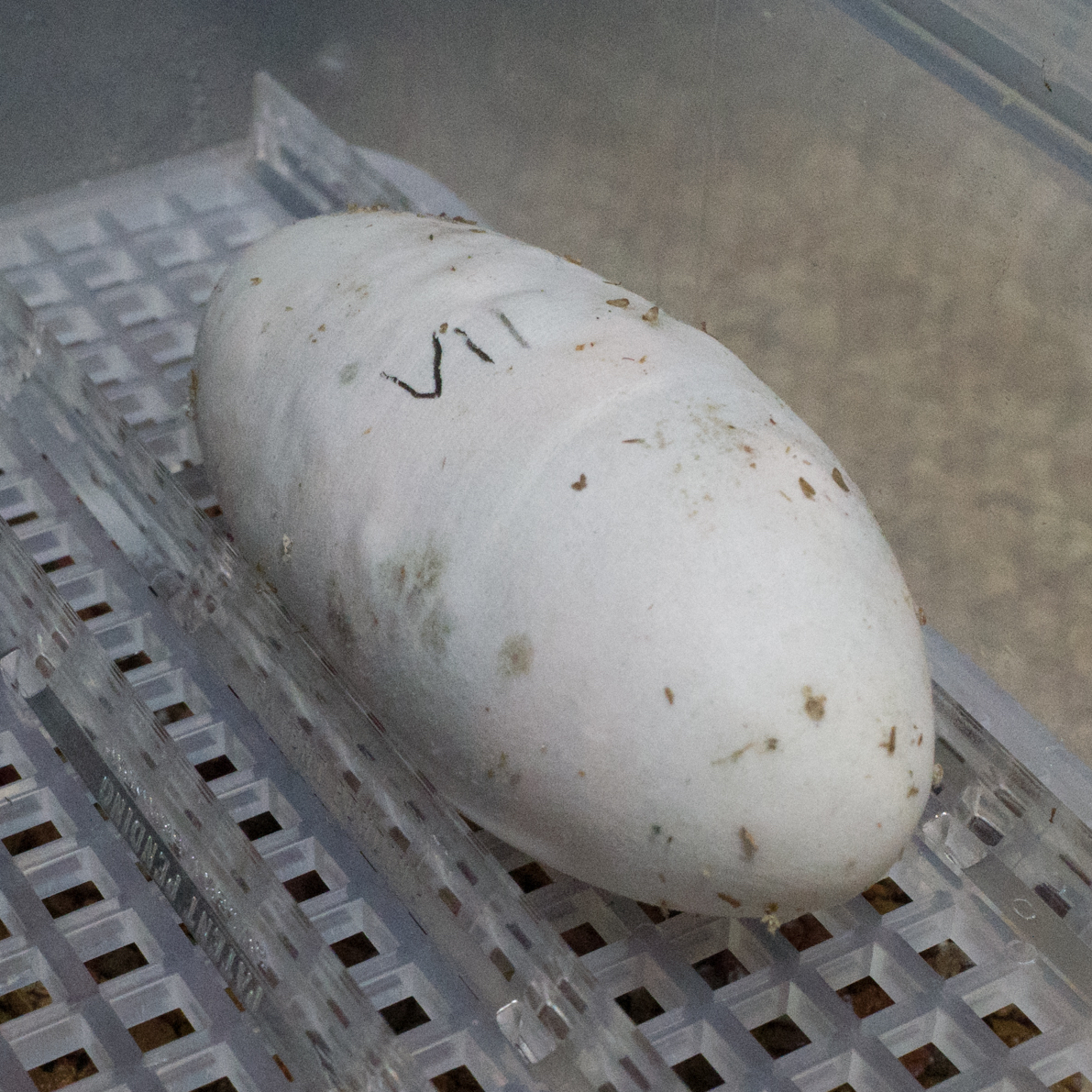
Patience. Patience is what those in the know say. Sure, I am checking the incubator at least ten times a day for any action and patience is not my virtue, but I am old enough to know when to listen. A couple a the eggs dented in over two weeks ago, the two others are starting to dimple (not dent) and in all honesty I would be surprised if any of them hatch at this point. If they do not hatch my biggest concern is figuring out where my failure was. Is it the incubator? No, the Grumbach’s are renowned for their reliability. Is it the S.I.M. egg container? No, these have been used successfully with Gila monsters before. My temperature, though low, should not be the issue and my humidity is spot on, so it shouldn’t be that. We just started having cold fronts move through and temps have fallen so that may have a slight play into it (I have ordered a space heater to remedy this issue). At this point my guess is that since the fan in the Grumbach is unplugged that there may not be enough airflow which may be an issue, or the fact that the Pangea Hatch medium has started to grow mold adds to this theory. I do open the incubator to allow fresh air to enter but it may not be enough. Whatever the case, I will hold on hope until the last egg turns yellow and starts to sweat. If they all die I will carefully review my protocols and notes and seek the advise of successful breeders to plan for a better year next season!
On another note, I have stopped feeding my adults and am turning off the lights and under-cage heating in preparation of hibernation, which will begin after Thanksgiving. I have an old refrigerator that is hooked up to a Ranco thermostat for the cool down. Would be great if I could cool them in their cages but we do not see steady enough low temps here in northern Florida to ensure the Gila will reach and stay at 53°F for the three months of brumation.
We are 132 days past oviposition and the remaining six eggs appear to be hanging in there. One of the eggs has dented in, which I am hoping means that it will hatch in the next few weeks and does not mean the embryo has died. The other eggs remain rigid and appear to be well, fingers crossed they come to term! The Grumbach has been great in maintaining the temperature and humidity stable throughout incubation, but I have noticed that the egg boxes have increased in temperature by 1°F higher than the incubator over the last few weeks. Condensation has also started to build up (mostly on the sides) so I’ve been keeping an eye on that to ensure none falls on the eggs potentially suffocating the embryo inside. Since the eggs were incubated at the lower end of the range it can be expected that the eggs will hatch (if they do) toward the later end of the spectrum, potentially 150+ days. Man, I can’t wait…
On the other side of the house my adult Gilas are getting ready for next year. Weekly feedings of 2-3 mice (2 for the males, 3 for the females) has brought all of the Gilas to a healthy state; good fat reserves in the tails and a constant, though not concerning, weight gain. As most of my group was purchased earlier in 2019 and after the hibernation cycle, I do not have data on what the pre-hibernation weights were last year but I think they are ahead as their weights are above pre-breeding numbers from this season. I hope to have more fertile eggs that make it to term in the upcoming season as they entire group will have been with me for the whole cycle.
Winter cooling is going to start in late November and this year a larger refrigerator / cooler is going to be purchased in order to facilitate all adults. I’ve noticed an increase in activity and feeding response in the adults over the past week, almost being as active as breeding season. I do not know if this has to do with growing follicles and testes, a reduced photoperiod, or slight drop in temperature (or maybe all) but it does seem that the Gilas are getting ready for a long winter’s nap!
That’s all for now, hopefully the next post is of the Gilas hatching!!
Not much has happened since the last update; one good egg died leaving me eight healthy growing eggs in the Grumbach incubator. A universal agreement on Gila monster eggs is to leave them the F* alone during the long incubation time. I have a hard time doing this but have been a good bean and done so by only check through the incubator’s clear door and light to make sure none are dying. The Grumbach is holding temps and humidity as it should; Temperature ranges from 77.5˚F to 79.5˚F and humidity in the incubator stays at a steady ±90% RH (relative humidity) with the Squamata Concepts S.I.M. egg boxes at 100% RH. I have three SensorPush sensors (one in each egg box, one in the incubator) connected to a SensorPush Gateway to monitor temperature and humidity. And the Gilas? All are eating and back to normal, with the females gaining weight nicely. I still find it interesting how the feeding habits changed so much during the breeding season and look forward to more data next year from this interring period of time.
The egg on the right was good with a solid blood ring and growing nicely with nice veins before it suddenly died. Not sure what happened as the others in the clutch continue to grow.
The sweating of the egg on the left is a sure sign of bad things to come.
These eggs look good and smell like fresh, moist soil. The SensorPush sensor is placed in each egg box to track temperature and humidity.
I wanted to post a few photos of good eggs and bad / dead eggs (see above) and discuss a few observations. When an egg goes bad, there is no mistaking it; they begin to sweat, discolor, and smell awfully. The good eggs remain turgid and whitish in color, with increasing veining (last I checked a few weeks ago) when candled. I do not plan to open the incubator door again unless something is going wrong or an egg dies, so hopefully they are growing and not just looking good….
My next post will be one on the tools being used in my program for Gila monster breeding and incubation.
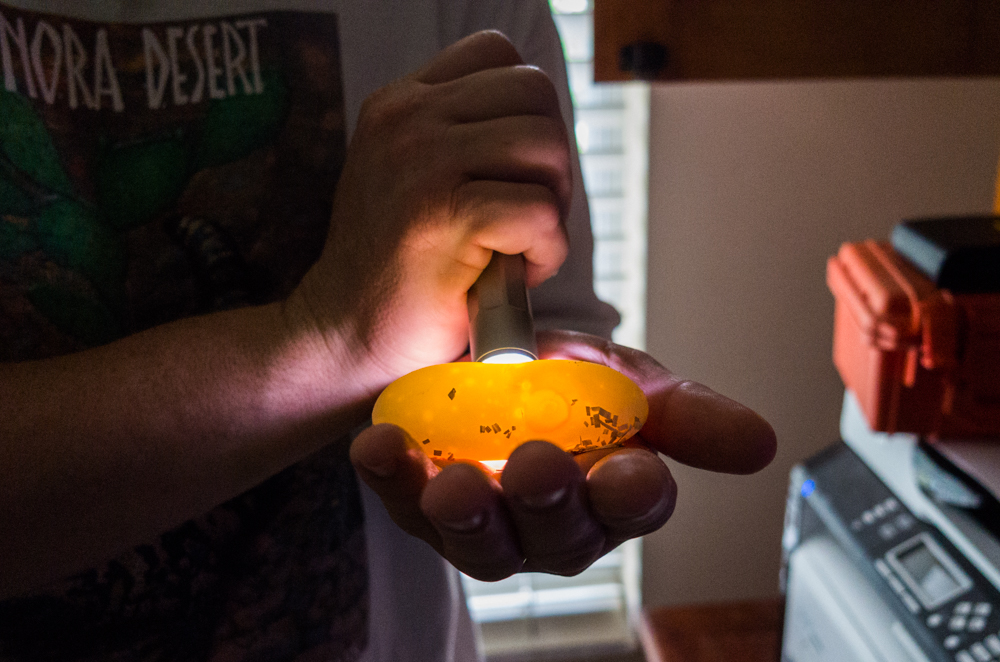
It’s been all quite on the update front as, well, there has not been much to report. Until now, that is! On Friday June 7, Gila 03 dropped one egg over the night and I came upon it at 6am when getting up for work. I candled the egg but did not see a blood ring (something that viable eggs have) but put the egg into an egg box just in case. For those that have not heard of this stuff yet, candling is using a flashlight to light up the egg to see what is going on inside. The blood ring is the blastoderm that will one day become a baby. No blood ring, no baby. Gila 03 did not drop her eggs in succession and the next one came Friday night around 10pm. This egg also did not look viable, but was more solid than the first. The third egg from 03 came Saturday afternoon and had a clear, but small (dime-sized) blood ring. I think 03 has more eggs in her, but she hasn’t dropped yet. Now when will little 05 drop her eggs….
Candling a freshly-laid Gila monster egg. The blood ring is readily visible upon inspection.
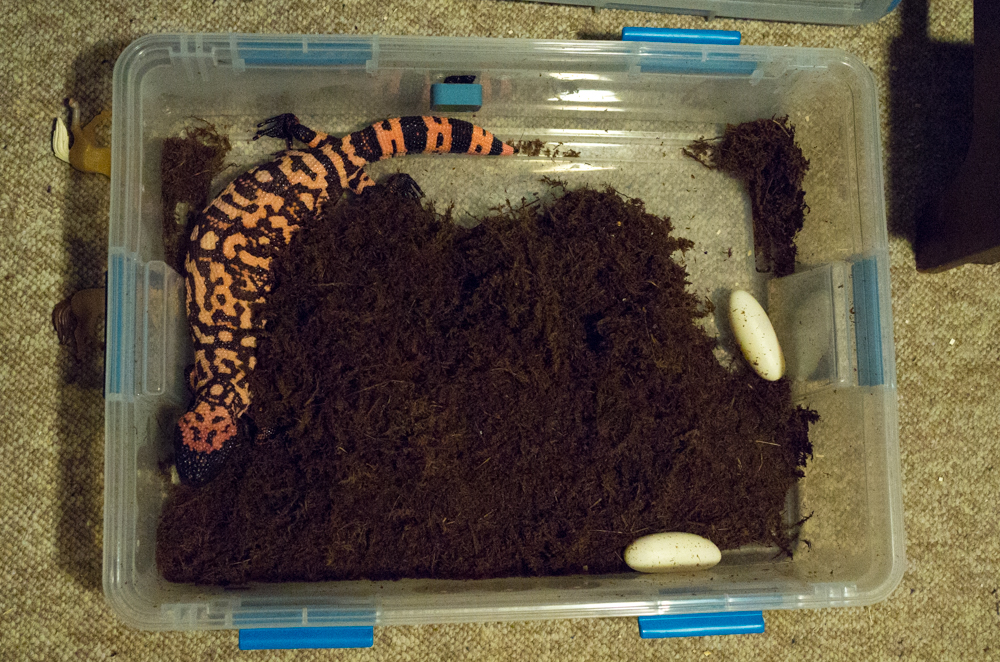
That answer came Sunday morning when I got up around 7am and two eggs were in the nest box. Two, beautiful healthy eggs! Now, 05 is on the smaller side (757 grams pre-breeding season) so I did not expect many eggs from her but over the course of the next eight hours she would go on to lay a total of six viable eggs! Poor girl, she looks exhausted.
Gila 05 “Heather” dropped her first two eggs over the night.
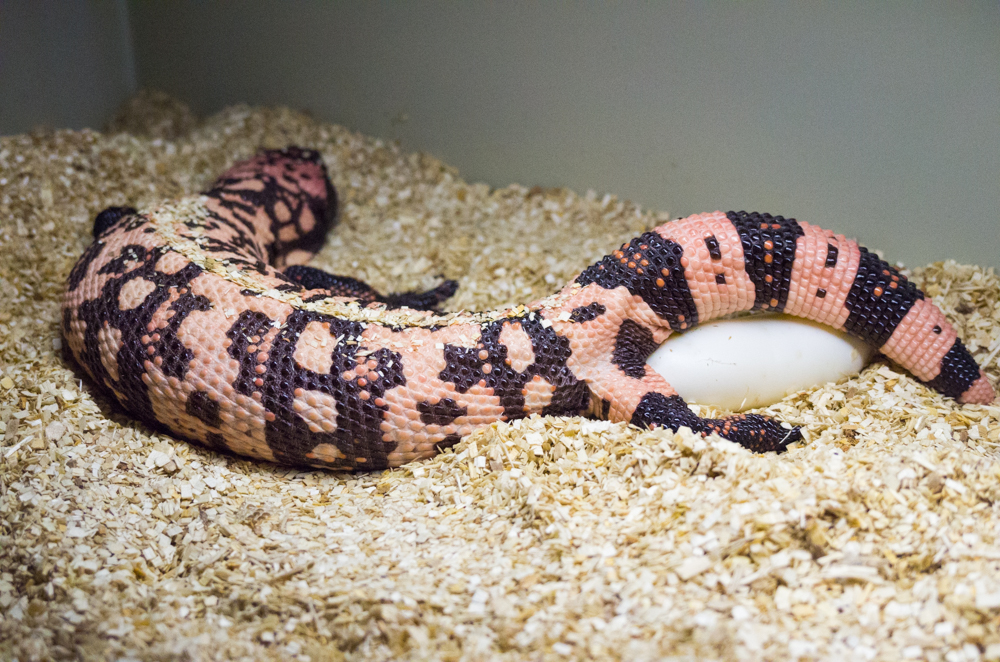
Heather on egg #4! Look at the size of that thing!!
Now is the hardest part, incubation. I hope everything is set up right in the Grumbach S84 as I’ve had the humidity (90%RH) and temperature (79°F) dialed in for a month now. I opted to go for a lower temperature as outside temps have hit over 100°F in May so I expect the Summer to be pretty hot and I do not want the eggs exposed to high temperatures.
I’ll post some more thoughts and data that have been collected in the meanwhile, but fingers crossed the eggs make it to term and we have baby monsters in the Fall!









 Patience. Patience is what those in the know say. Sure, I am checking the incubator at least ten times a day for any action and patience is not my virtue, but I am old enough to know when to listen. A couple a the eggs dented in over two weeks ago, the two others are starting to dimple (not dent) and in all honesty I would be surprised if any of them hatch at this point. If they do not hatch my biggest concern is figuring out where my failure was. Is it the incubator? No, the Grumbach’s are renowned for their reliability. Is it the S.I.M. egg container? No, these have been used successfully with Gila monsters before. My temperature, though low, should not be the issue and my humidity is spot on, so it shouldn’t be that. We just started having cold fronts move through and temps have fallen so that may have a slight play into it (I have ordered a space heater to remedy this issue). At this point my guess is that since the fan in the Grumbach is unplugged that there may not be enough airflow which may be an issue, or the fact that the Pangea Hatch medium has started to grow mold adds to this theory. I do open the incubator to allow fresh air to enter but it may not be enough. Whatever the case, I will hold on hope until the last egg turns yellow and starts to sweat. If they all die I will carefully review my protocols and notes and seek the advise of successful breeders to plan for a better year next season!
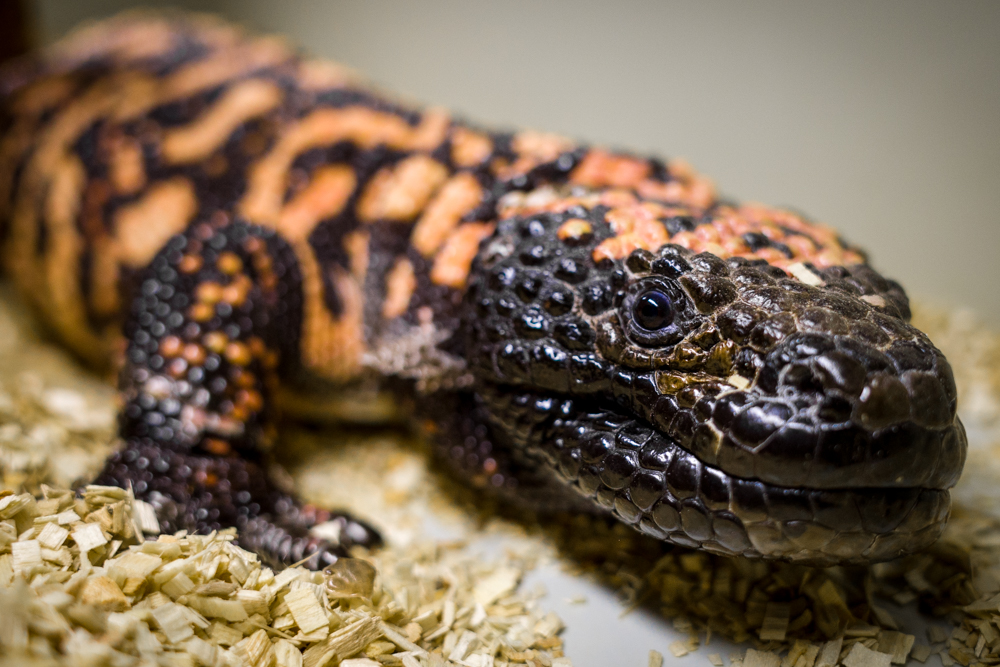 We are 132 days past oviposition and the remaining six eggs appear to be hanging in there. One of the eggs has dented in, which I am hoping means that it will hatch in the next few weeks and does not mean the embryo has died. The other eggs remain rigid and appear to be well, fingers crossed they come to term! The Grumbach has been great in maintaining the temperature and humidity stable throughout incubation, but I have noticed that the egg boxes have increased in temperature by 1°F higher than the incubator over the last few weeks. Condensation has also started to build up (mostly on the sides) so I’ve been keeping an eye on that to ensure none falls on the eggs potentially suffocating the embryo inside. Since the eggs were incubated at the lower end of the range it can be expected that the eggs will hatch (if they do) toward the later end of the spectrum, potentially 150+ days. Man, I can’t wait…
 Not much has happened since the last update; one good egg died leaving me eight healthy growing eggs in the Grumbach incubator. A universal agreement on Gila monster eggs is to leave them the F* alone during the long incubation time. I have a hard time doing this but have been a good bean and done so by only check through the incubator’s clear door and light to make sure none are dying. The Grumbach is holding temps and humidity as it should; Temperature ranges from 77.5˚F to 79.5˚F and humidity in the incubator stays at a steady ±90% RH (relative humidity) with the Squamata Concepts S.I.M. egg boxes at 100% RH. I have three SensorPush sensors (one in each egg box, one in the incubator) connected to a SensorPush Gateway to monitor temperature and humidity. And the Gilas? All are eating and back to normal, with the females gaining weight nicely. I still find it interesting how the feeding habits changed so much during the breeding season and look forward to more data next year from this interring period of time.