Loading screen from The Bard’s Tale (one of the first computer RPG’s from 1985)
The Gila monsters at Goatsby’s Place are waking up after the long winter’s nap, officially kicking off the 2025 Gila monster breeding season!
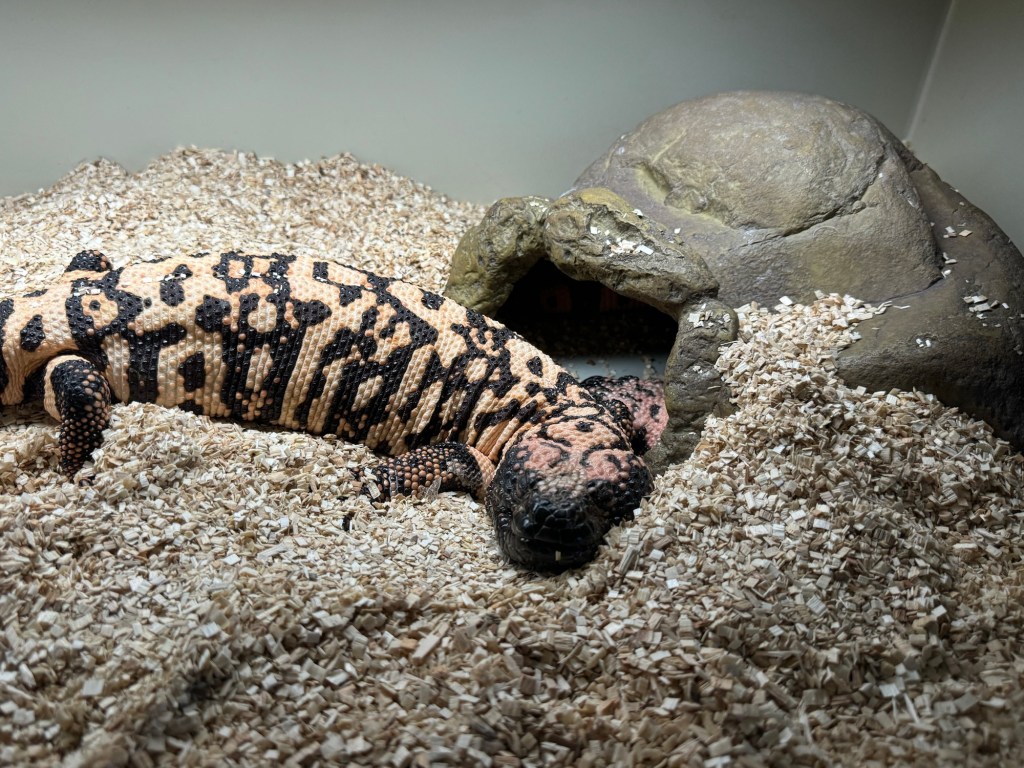
One of our newer additions is waking up after being brumated since December. It takes them a week or so to really get moving again.
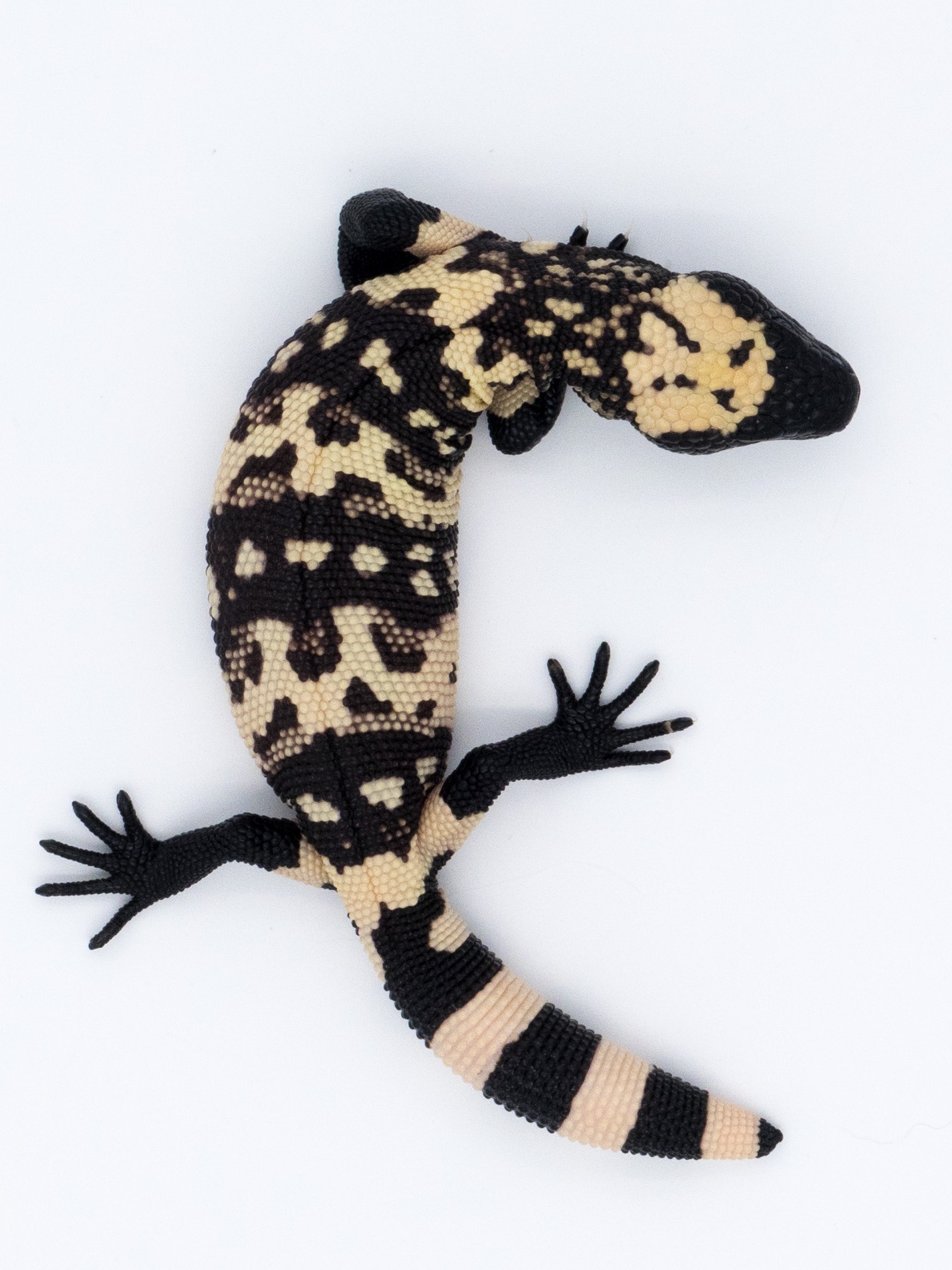
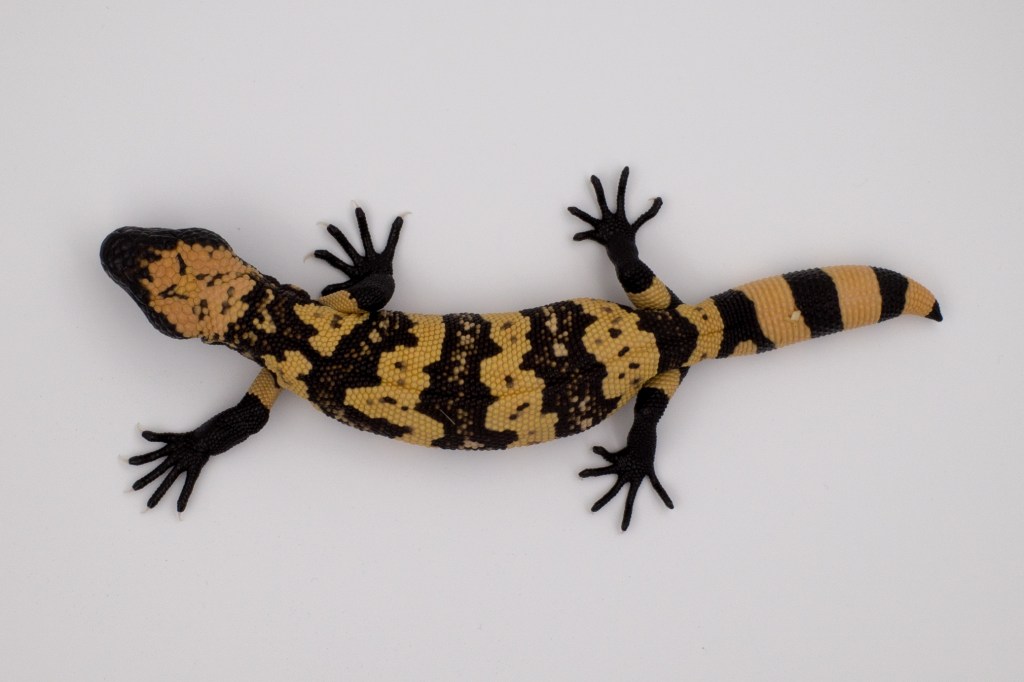
Every year starts off with a lot of hope, but this year is even more hopeful as we have a lot of exciting things going on this season. We have a pair of beautiful banded Gilas that are new to the mix, and two females that bred for the first time last year (one is Winnie the Seward axanthic Gila, the other is the stunning pink banded Gila Lucy), and our stalwart females Heather and Belle will be in the mix again this year as well. As the Gilas wakey wakey I will start ultrasounds this weekend and feeding begins next week. First will be small meals of single adult mice, and once they defecate regular feedings will begin.
Lucy was not bred last year to build her weight and strength to successfully breed this year.
Stay tuned for more updates and photos, and if you wish to get on our list for 2025 please do so earlier than later. We have a healthy list already (many are repeat customers which is amazing!) and as a smaller-scale breeder, babies will be limited!
This is the third attempt to update everyone on what the haps be here at Goatsby’s Place and more importantly how the Gila monsters are doing. Every year of breeding Gila monsters brings new insights, challenges, and the understanding that my knowledge of these fascinating lizards is always less than I think. Emotions throughout the season range from hopeful and excited, to perplexed and frustrated. At the end of the day it’s a wholly humbling experience living with the world’s most intriguing reptile.
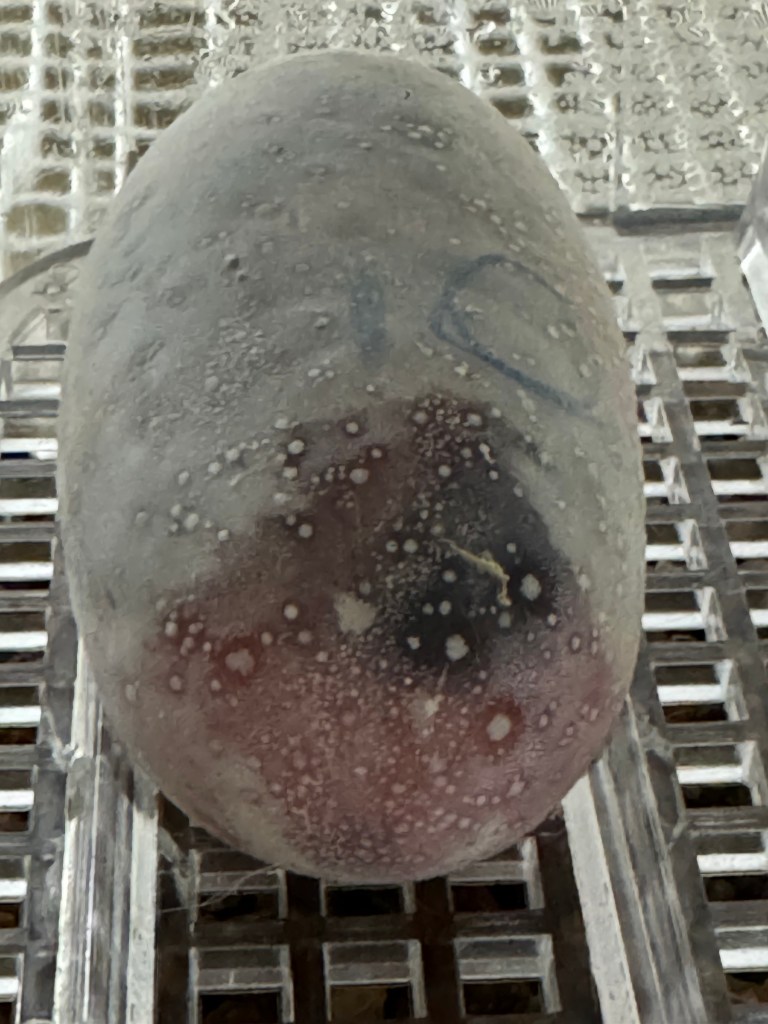
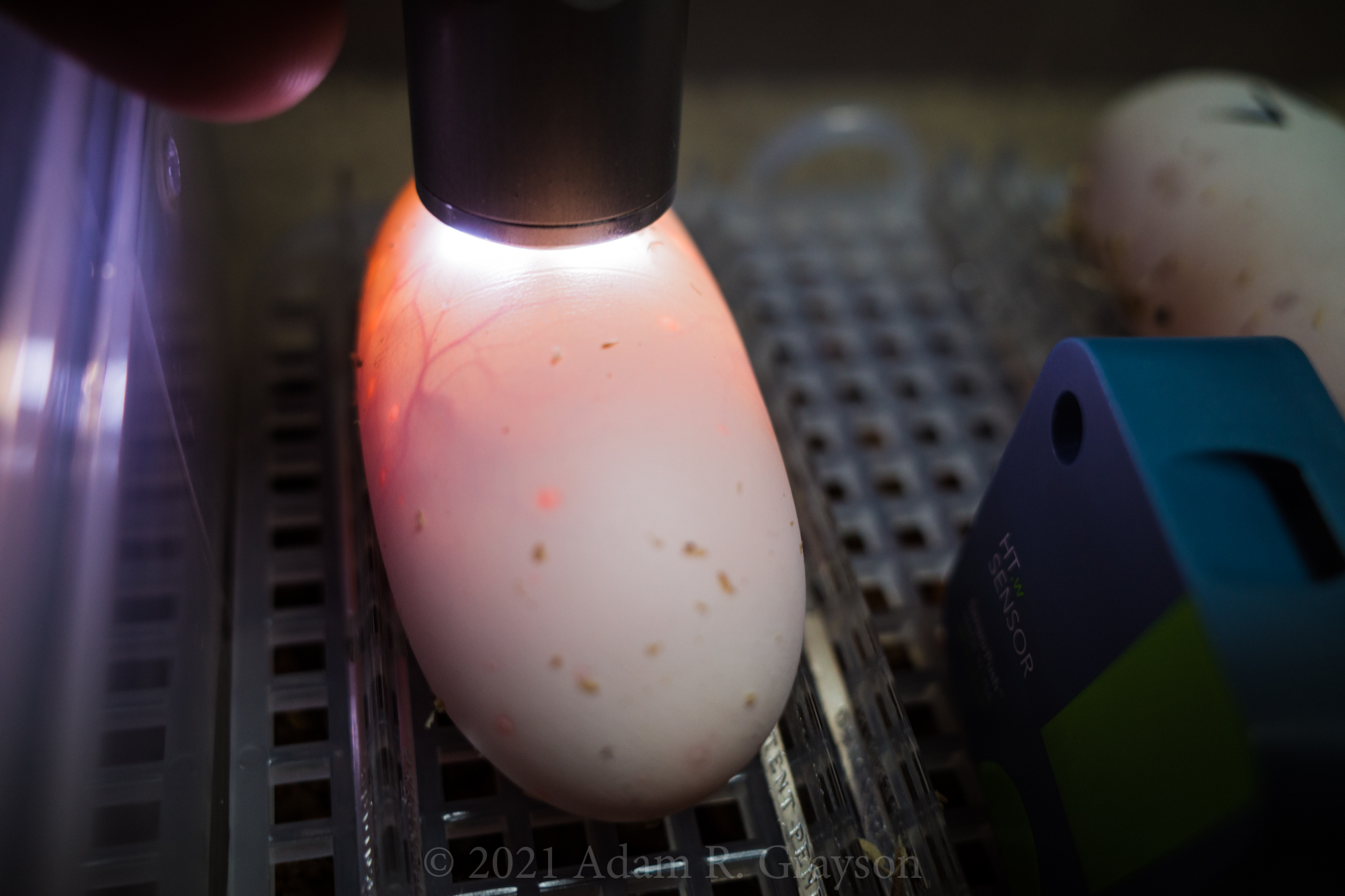
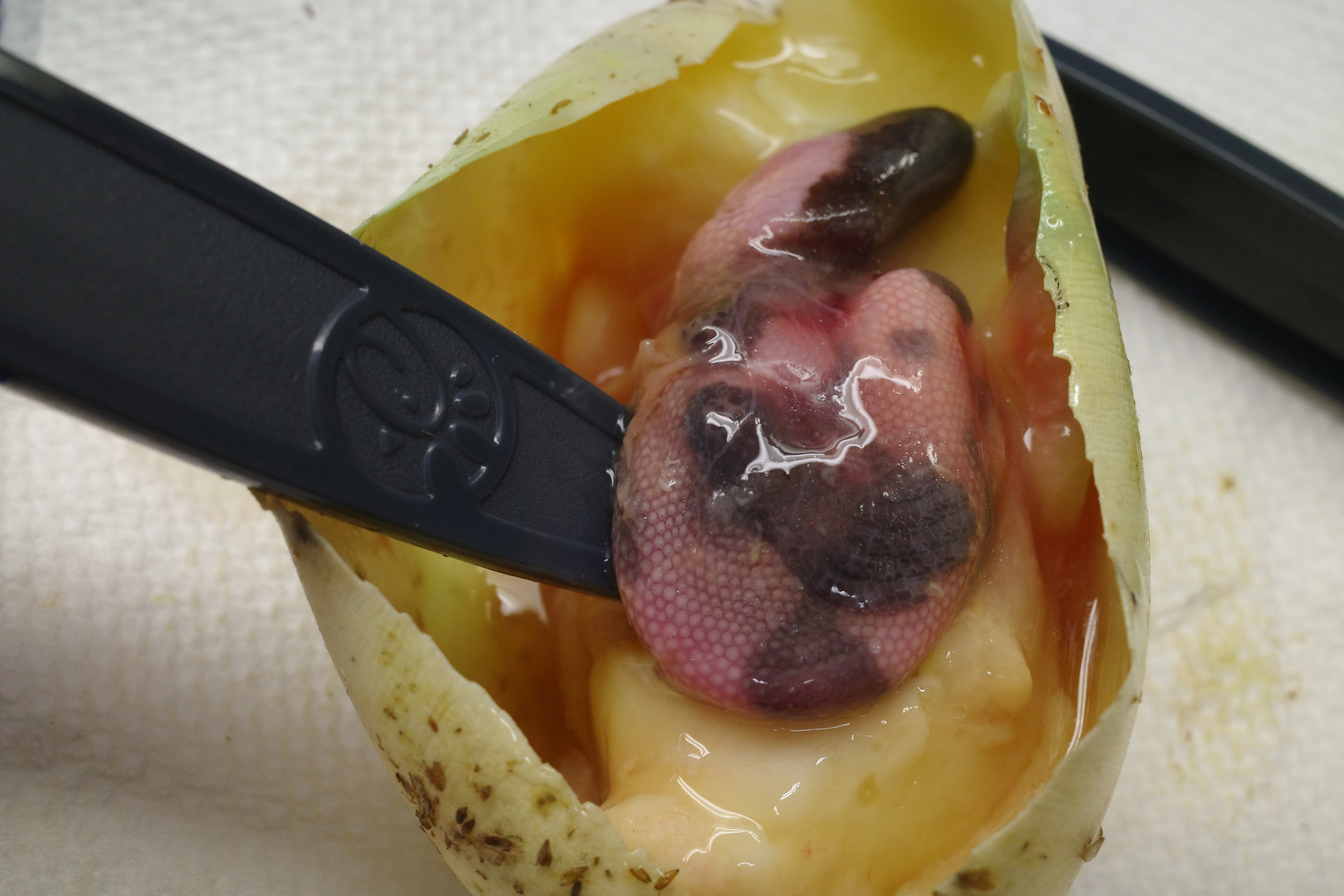
I love when we can start to see the coloring through the egg!
First thing, 2024’s Gila monster breeding season yielded four good eggs (out of 17 total laid) that are looking likely to hatch. With T-15 days to hatching I’m hopeful they’ll make it all the way. There are few things as exciting (to me, at least) as seeing baby Gilas emerge from the egg. I vividly remember reading Dr. Seward’s book and that iconic photo of a baby coming out of the egg dreaming one day this would be a reality. Six years into successfully breeding Gila monsters brings me no less joy!
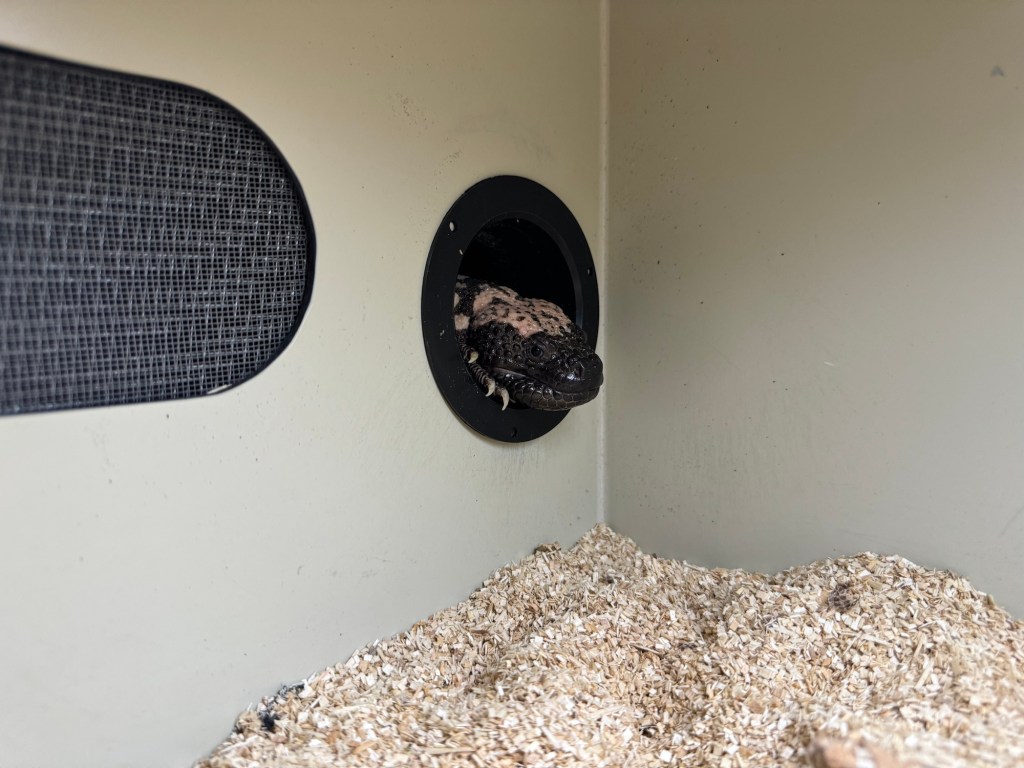
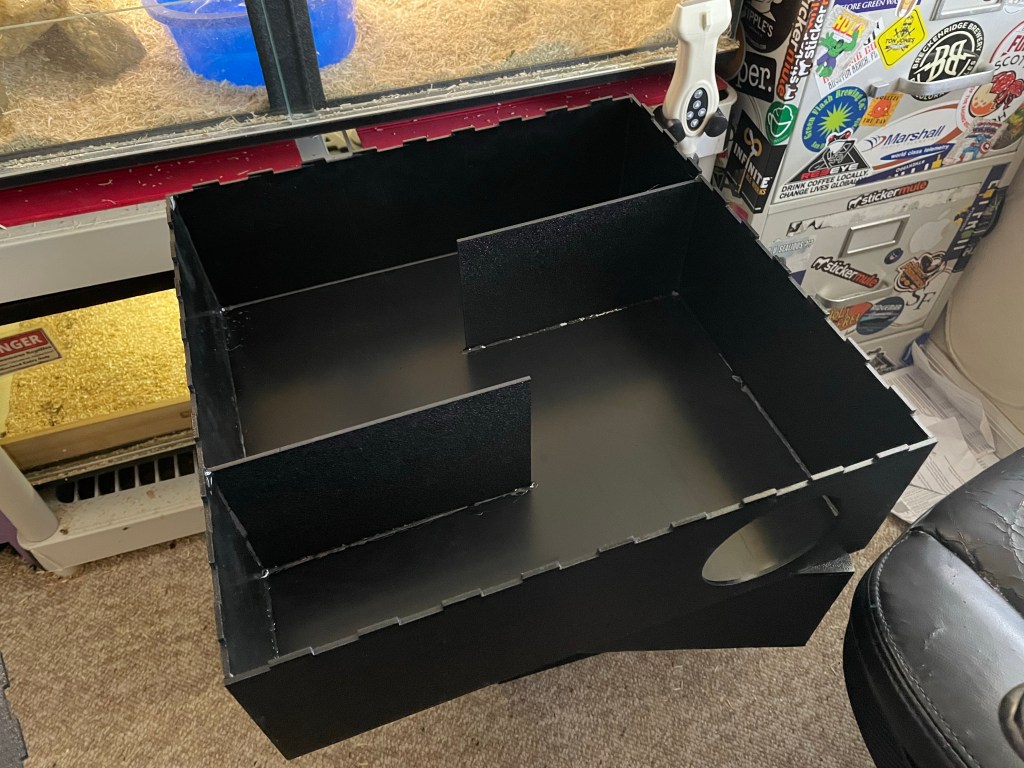
The connected nest boxes, so the female can go in and out and dog around as she pleases.
This year we tried some new things to help increase viable eggs including connecting cages for paired males and females, nest boxes connected to the cage , and having monogamous pairs throughout the breeding season. We had a total of four pairs, two stalwart females and two first timers, and a male that just came to age and bred his first time. All were cooled last winter and testes and follicle growth was good.
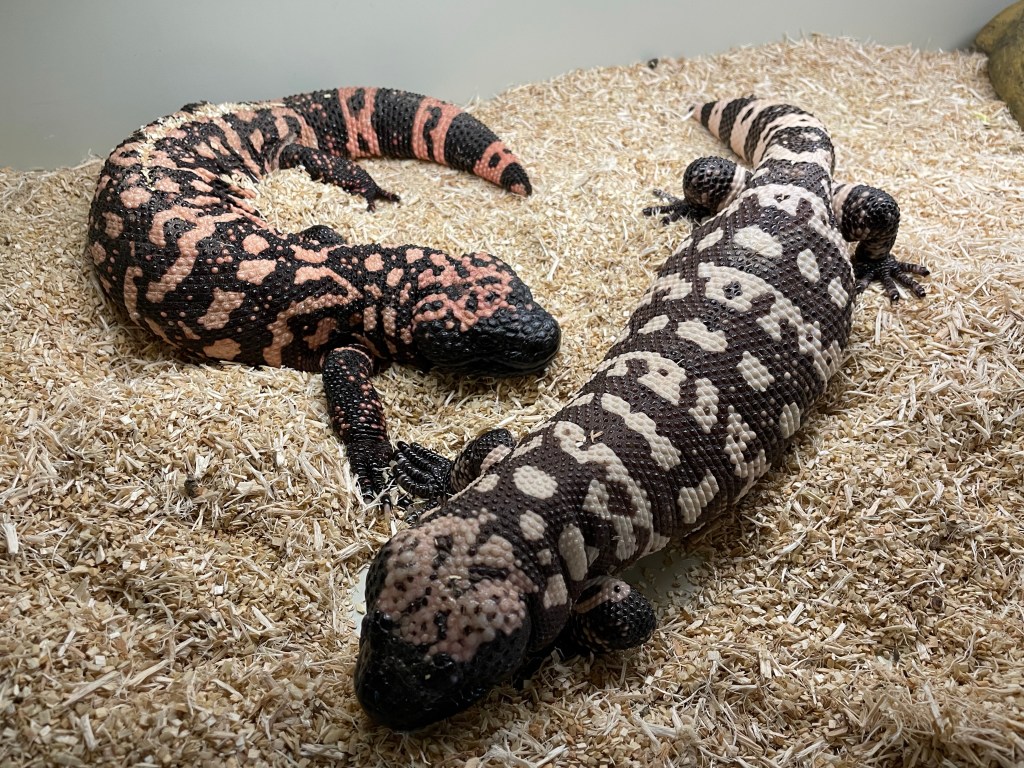
Snuggle time, Gila style
But, all is not as it seemed under the ultrasound as three females produced, the first timer axanthic produced all slugs, and one female did not produce any eggs. It later turned out the the newbie male she was paired with had a shrunken testicle that was the start of a hemipenal impaction – didn’t see that coming. So, four eggs this year and I’m perfectly happy with that.
Female buried in the new nest box
There’s more to cover for the season, but wanted to share this update for now as we count down the day to 2024 captive born baby Gila monster hatchlings! Thanks for stopping by Goausby Place!
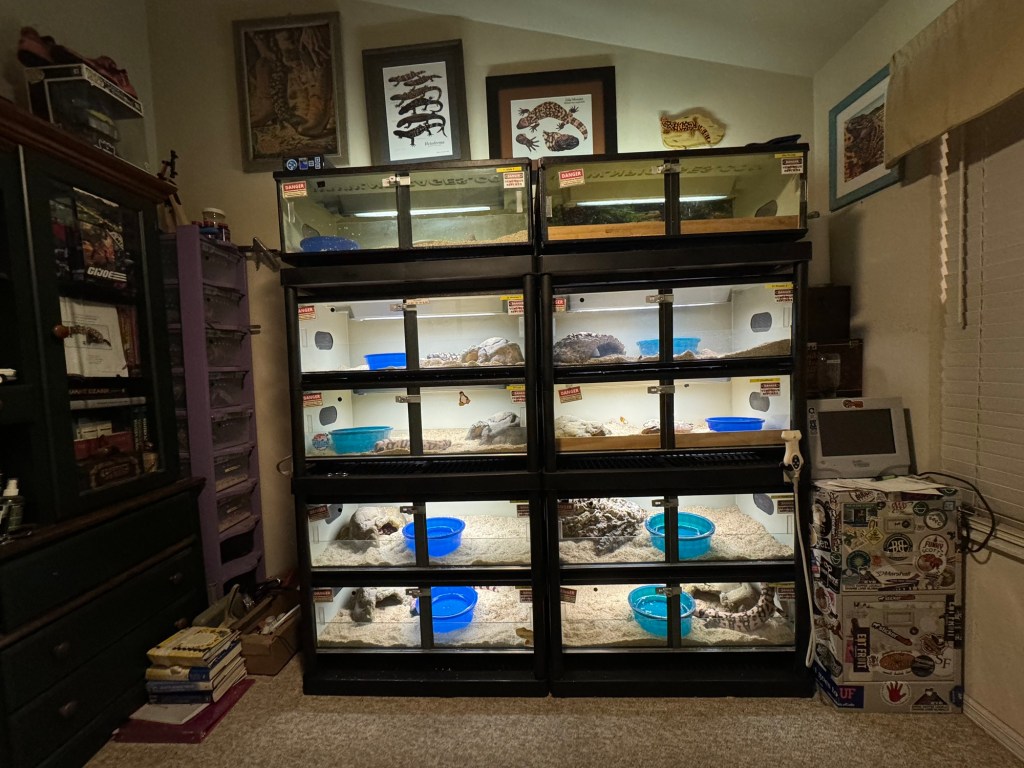
It’s been years since I’ve made any significant changes to my Gila room – some in part of there not being a real need and another part of good old fashioned laziness. But, after last year’s limited success and the driving need to do better and innovate (not to mention that my Neodesha NPI stackable cages were tilting ever forward like the Leaning Tower of Pisa) I got off my butt and went back to the drawing board.
Thinking of where my shortcomings have been (nesting, still), the fact that these stackable cages have shown those Achilles heel, and taking inspiration from my Gila Amigo John’s “Gila Hilton”, the design objective was to have cages stacked two high for stability, interconnected laterally for male-to-female interactions, and with a separate nest box attached to the female side to encourage nesting. The design went through a few drafts but ultimately it came out like this..
See the big difference? That’s ok, neither do my wife or kids..😜
Misty wishing the giant eggs inside her would disappear. Note the sunken eyes and thin tail.
It’s been a while since I’ve posted or made a video, mostly because kids, work, and daily life keep me busy, but also because it’s been a tough year with the Gilas. It’s been hard to get excited with season that showed so much potential. Four females were being bred, including the axanthic Gila and one of my babies from 2019, new nest boxes were designed and created, and there was a record amount of coplulation observed. As of mid-May everything was going according to plan. There was a lot of observed copulation, the female Gila’s were utilizing their new nest boxes, and ultrasound showed growing follicles. So, where did it all go wrong?
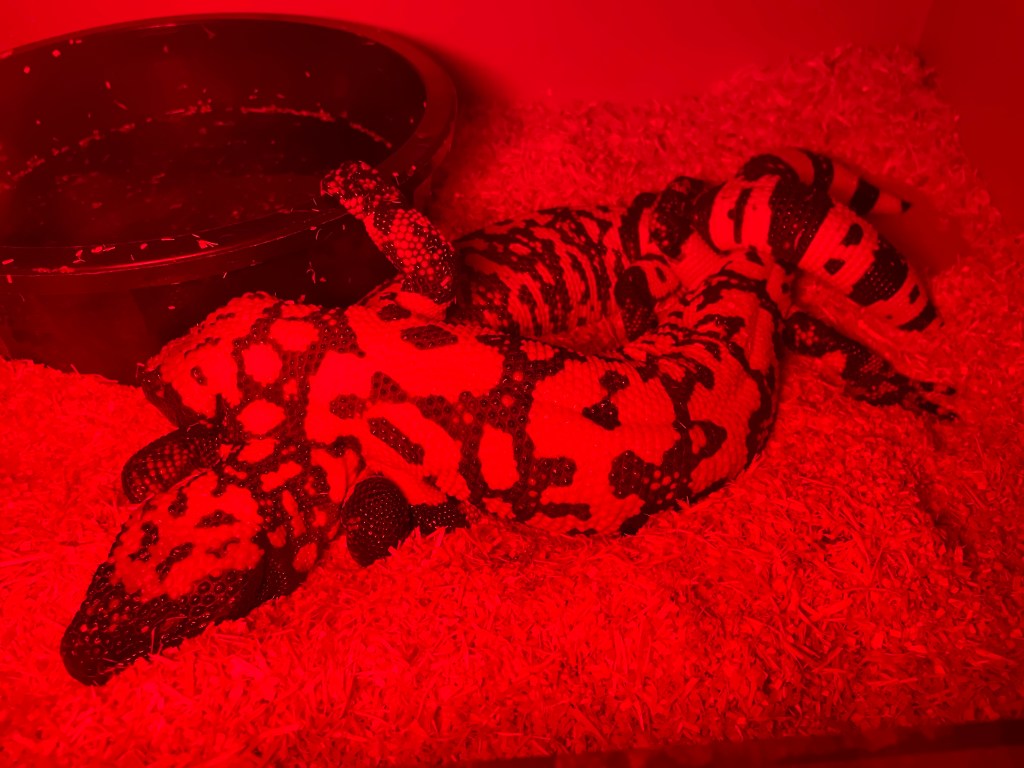
Red-light district, Gila style.
Pre-egg laying shed (or PELS as I call it).Winston and axanthic Winifred getting to know each other.
The first fly in the ointment was the axanthic female’s follicles were not maturing. Not at all. The axanthic Gila was not brumated in 2021 but was cooled in 2022 so her timing may be off, but only time will tell. Fingers crossed for next year.
Heather guarding her nest box very aggressively.
Next up was my nesting situation. I still think this is my biggest issue. I have no problem getting fertile eggs, and good eggs make it to term so my incubation technique must be working, but its the in-between nesting period that is getting me. So, this year I designed new nest boxes based on many hours of research and then custom-made for me by James at All American Cages. The boxes were chambered to allow the female to dig a suitable nest in privacy and fill it back in, but still allow me to check with a removable top. I put the boxes in the cages after the pairs were split in May and the females didn’t;t waste much time exploring the boxes and ultimately retiring to them for oviposition. Unfortunately the the females still laid late which, to me, caused some of the eggs to be infertile. I think I have a good idea what is going on and next year will prove my theory out, but it is likely the females must have complete quiet and secrecy to feel comfortable enough to deposit the eggs. How many wild nests have Gila researchers ever been able to find, in recorded history? One. Only one. And that was only found because a construction crew accidentally dug one up! For next year I am going to reimagine my set up. Not sure how yet but have a few ideas, stay tuned folks:)
My new nest box with chambers. Nest box filled in, mom on guard on the right!
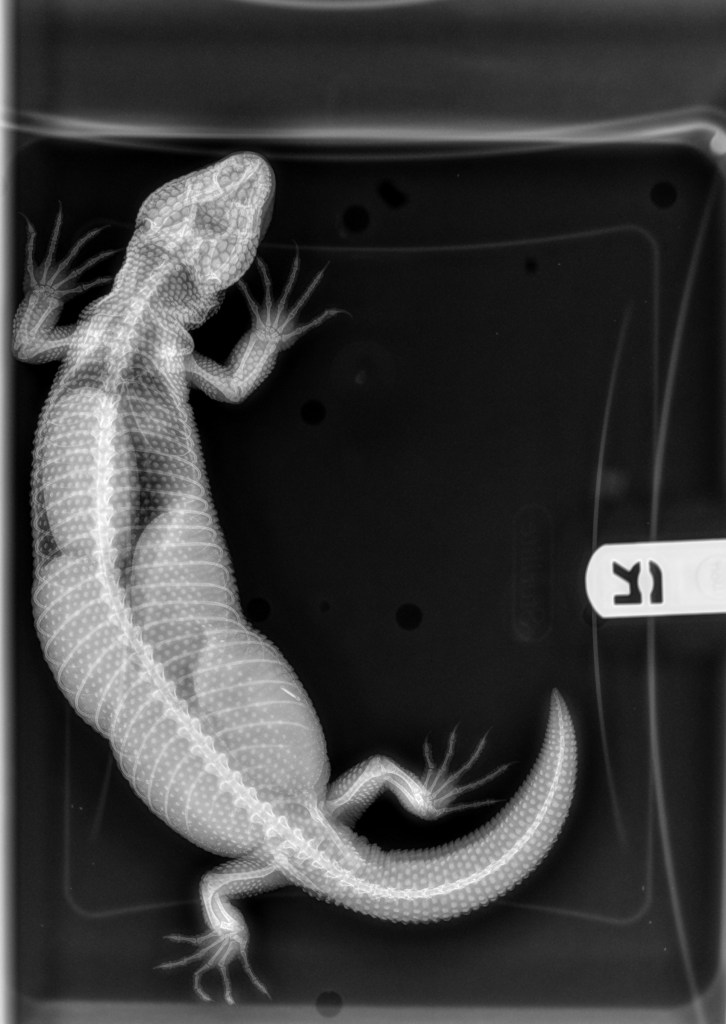
And last, but certainly not least, of this year’s woes was when my 2019 female Gila being bred for the first time got egg bound (or dystocia). My other females Gila lay early to mid-June like clockwork. Even when things aren’t going right the majority of the eggs are laid at this time (though a slug or two may come earlier or later), so when late June hit and Misty wasn’t laying I started getting worried. She started to lose even more weight than a normal female Gila does during the time of oviposition and still refused to eat, so early July I brought her to my vet to see what they thought. An X-ray showed five big beautiful eggs stuck in my little Gila and recommended removal by surgery at the University of Florida. While I had given the idea of waiting longer to see if she would lay some thought, anecdotal accounts universally gave bad prognosis for waiting too long – all cases I read either ended up with the female oviduct being removed altogether, or sadly in death of the Gila. Neither outcome seemed good tome so I did not want to wait any longer and scheduled the surgery the next day. I am very lucky to live in a college town with one of the country’s top veterinary schools (University of Florida, Go Gators!), but I also had the luck of getting one of the best reptile vets to perform the surgery (a big THANK YOU to Dr. Jim Wellehan and his team for the professional care and expertise on my dear Misty). Dr. Wellehan did his best to ensure Misty would be able to breed again, but only time will tell. At a minimum she will take next year off to recuperate but I will monitor follicle progress via ultrasound and see how things go. So far Misty is doing great, her incision wounds are healing well and she is eating like a champ!
X-ray showing five honking eggs in this female Gila monster. If you look closely at the egg nearest the head, you can see the heart and lungs pushed to the side! Eggs protruding from the belly, does not look comfortable!The day after surgery, looks painful but relief is on the way Misty!
To say that this year, which held so much promise, was a tough year is an understatement. As I always do after breeding season, my notes will be read and re-read, I will review ultrasound images and video, and think of how to improve next year. I have a few thoughts, mostly with nesting, but there may be some major changes coming up. Regardless, I still have good eggs in the incubator and any year that ends up with baby Gila monsters is a good one in my book!
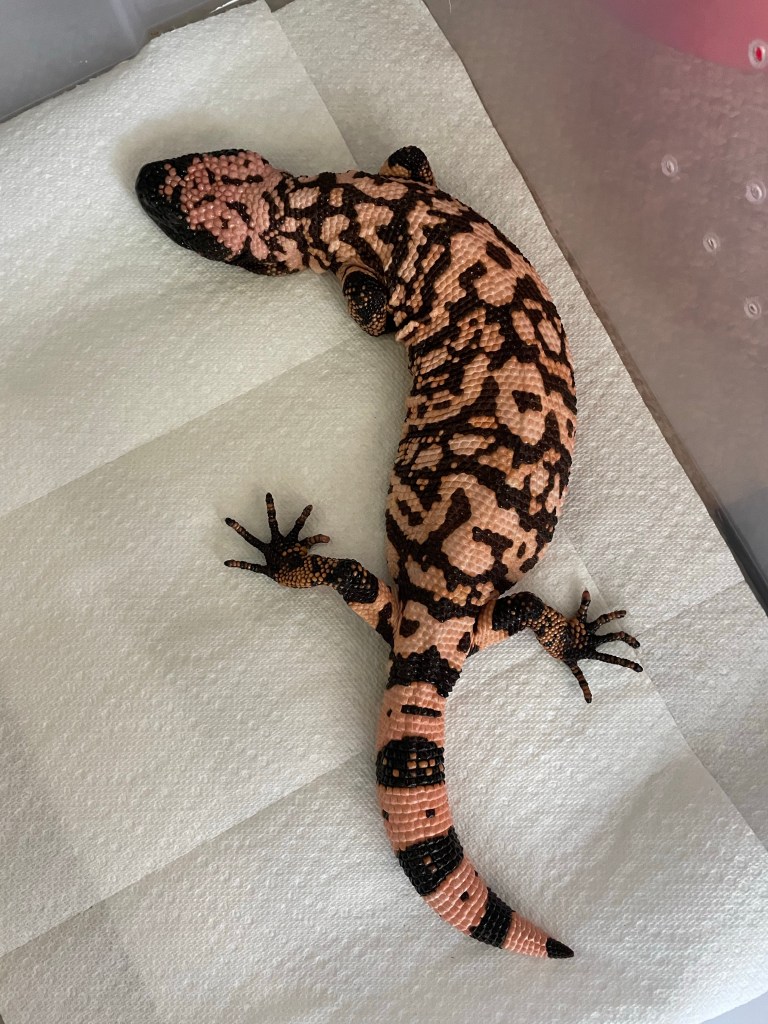
Misty recovering well on paper towels. It was tough to lose the eggs but certainly worth it to save the girl!
Kicking off the 2022 Gila monster breeding season seemed like a time to start our YouTube videos. We plan on documenting the entire breeding season, from warm up to hatching babies, to help expand the knowledge of breeding Gila monsters in captivity. Check it out here and let us know what you think!
Gila laying egg in hide box, which was moved to remove the egg.
This year started off with promise, but there was an asterisk overshadowing success. A total of twelve eggs were laid between two females (which has been the consistent average over the past few years, six eggs per female) which was good, and all appeared promising with blood rings in all eggs. The asterisk earlier mentioned comes from two factors; 1. I did not cool one of my adult males last year but still paired him with the females, 2. my main man Winston wasn’t too interested in the girls this year. I do not know if it was because I rotated my pairs, or “he was just not that into her” as the saying goes. Winston was only observed coplulating 3 times in 2021, versus 11 times in 2020. While I have hope for success this year, it is tinged in skepticism and truly illustrates how little we know about breeding Gila monsters in captivity.
Fertilized egg, showing blood ring (blastoderm).
Unfertilized egg, no blood ring present.
Of course success can be had following “The Recipe” as beautifully laid out in Mark Seward’s book but, much like cooking, following a recipe gets the basic job done but does not give us the insight into the inner working of what is really going on.
Egg about one week after being laid, showing veins which indicates growth.
In spending years studying Heloderma suspectum; collecting articles, reading books, and joining and participating in online forums and Facebook groups, the realization that my success as a breeder has been a lucky coincidence came hard and fast this year. I would love to take credit for the success I have been fortunate enough to experience, but as stated in Jurassic Park I have simply taken what others have done successfully and applied it to my program. If it’s not broken why bother fixing it, right? If all eggs hatched and there were no issues, hard questions would probably not be asked. As this year has brought more failure than success (so far) it is hard not to face the fact there is much to learn. Since it is a universally known fact that Gila monsters are hard to breed in captivity, it seems this lack of knowledge goes well beyond my program.
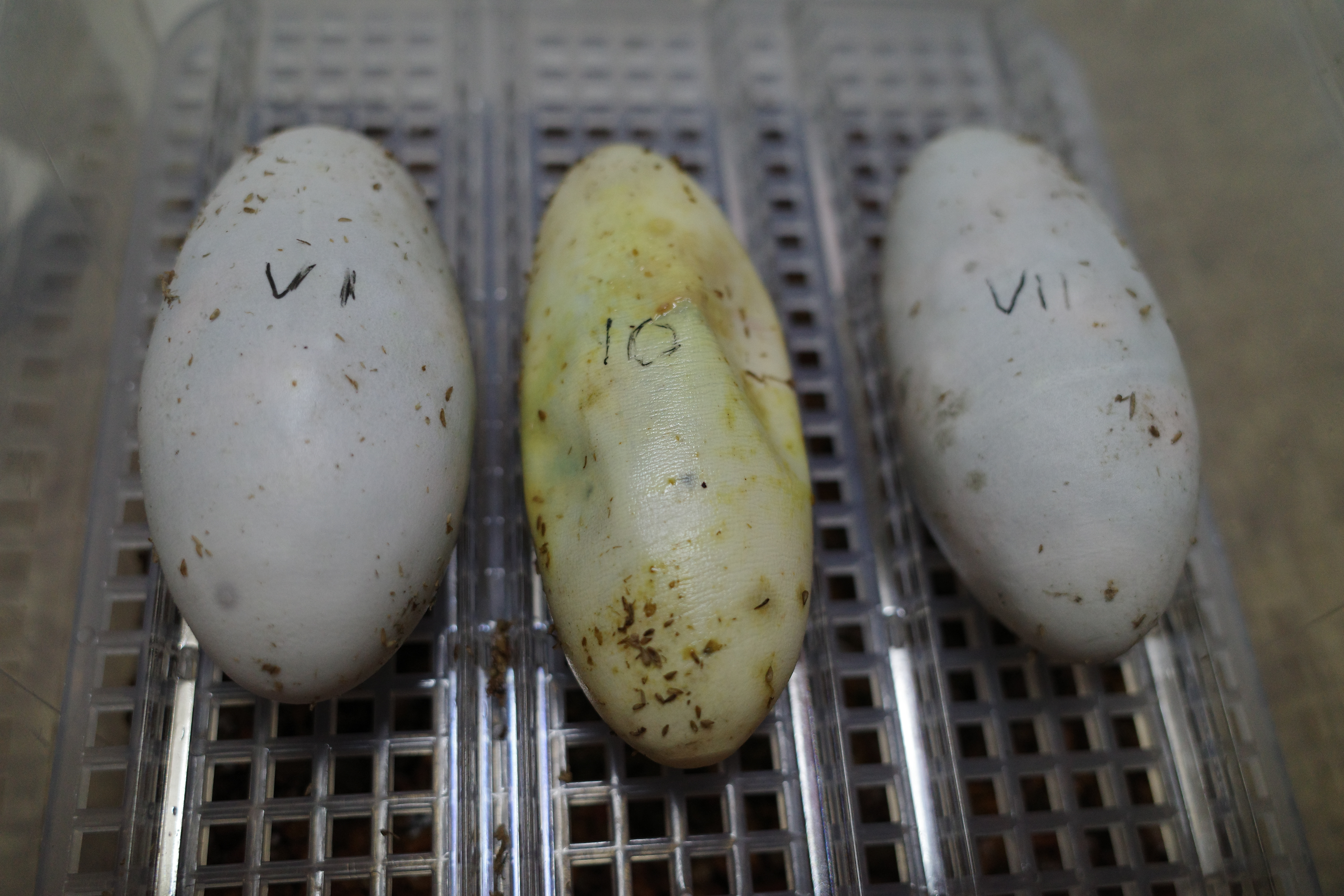
Some of these eggs are bad, can you tell which ones? Here’s a hint, three are bad (insert sad emoji).
Another unfriendly first this year was an infestation of phorid flies in my Gila monster egg boxes. As this pest has not plagued me yet, it was unnerving to find maggots on dying / dead eggs, and some on good eggs. Did the phorid fly maggots cause the eggs to die, or were they simply drawn to the smell of the decomposing matter? From what I have gathered by speaking to other reptile breeders and checking forums, the maggots do not cause they egg to due, but I am not 100% sold on that answer. Before getting into that topic, it would be good to share what was done to get rid of the fly infestation.
Upon discovering the phorid flies and maggots on my Gila monster eggs (after a releasing a string of expletives that would make Anthony Bourdain blush), the best course of action in my mind was to sterilize the egg boxes (S.I.M containers) and medium (clay Pangea Hatch) and close up all holes in the egg boxes. S.I.M. containers do not come with any holes from the factory, so when I first received them four holes were burned with a soldering iron into the top of each side to allow for greater oxygen exchange. These were now sealed with electrical tape so as to not allow entrance of the flies to lay eggs. After sealing the holes, the boxes were sterilized. The Pangea Hatch clay substrate can be boiled to sterilize, which is what was done to ensure no fly eggs would hatch from this area. After everything was cleaned the Gila eggs were gently scrubbed with a soft toothbrush to remove any fly eggs and then put back in, egg box tops then sealed to prevent further entry. Since then I have not seen any fly or maggot activity, though I do open the boxes every two or three days to make sure of this as well as provide oxygen exchange.
I forgot to mention that one egg was separated from the rest as this egg has a “weak” spot. When the cleaning occurred this part of the egg was covered in maggots attacking this area. I assumed this egg was a goner and would be the next to die, but as of today this egg remains viable. The soft spot has since hardened and no further maggots have been found on the egg! It is my belief that if left in the container with maggots and flies, this soft area would have been continued to be exploited which would have further weakened the egg and eventually would have led to its demise. Of course without having a control specimen to compare it to, we will never know if this egg would have continued to survive or would have died but my money is on the death of the egg. Ultimately the hatching of this egg will be the determining factor of this experiment, so fingers crossed a beautiful Gila monster comes out later this year!
Bad egg being attacked by phorid fly maggots. Do the maggots harm good eggs in the same container?
With roughly 77 days until hatch, there is a lot that can happen. As my Grumbuach S84 keeps the temperature and humidity steady as a rock, I can only look at the other variables in my program for improvement. Every year new challenges arrive in breeding Gila monsters, and there is always something new to be learned. Unfortunately mistakes come at the cost of viable eggs and hatchlings, but there is always next year to make improvements!
Our 2021 Gila monster breeding season has kicked off and we could not be more excited! All pairs have been seen copulating and follicles appear to be nice and healthy. We hope to correct last year’s mistakes and improve our program through the insights gained over the past few seasons. We are also now incorporating the use of ultrasound (we’ll post more on this once we’ve actually figured this technology out). Stay tuned on the haps here at Goatsby’s Place and our amazing monsters, much more to come!
It’s mid-February, the adult Gilas are slowly coming out of hibernation, the 2020 babies are going to new homes, and to say we are excited about the 2021 season is an understatement! This year we have an ultrasound that will help us improve breeding and oviposition, and we will share some information on this here once we can successfully figure it out:$ If you are interested in getting on the list for 2021 or just want to discuss monster, drop us a message!
In case you haven’t seen them, here are 2020’s babies!
Some time has passed since the last blog post (my sincerest apologies, I am a terrible blogger). What’s been going at Goatsby’s Place since we last wrote? Besides the usual life stuff (family & work) the babies are doing great and growing like weeds. Of all the baby reptiles I’ve worked with Gila monsters are the only species that have not given me an issue to start feeding (tree vipers, I’m looking at you). Some of the neonates take a little longer to eat the pinky, but they all ate on the first offering. They all have different personalities, some are very laid back, others are angry and more nippy, but all are amazing. It’s going to be tough to choose which one will be held back but I do have a favorite:) The babies are all housed individually in 18 quart Sterilite Ultra boxes and taken out to feed twice-weekly and be weighed every two weeks. A small 20 ounce water bowl is in the box for them to drink, soak, and sometimes defecate. I had smaller bowls at first but found they soiled them or knocked them over too easy and made the move to a larger bowl which is where I will start next time. They have been a blast to watch grow and I look forward to seeing how they mature.
The adults are back in the fridge resting at a chilly 56°F until early March. I hope to get a new female for next season but think I’ll have my hands full with the ones here. I look forward to building on the success of this season and hope to improve things next year.
That’s it for now, here are photos of the babies taken today. Shoot me an email if you are interested in any of them. One of these days I will get this website fully functional with and will try to not so much time lapse in-between posts. Thanks for stopping by!
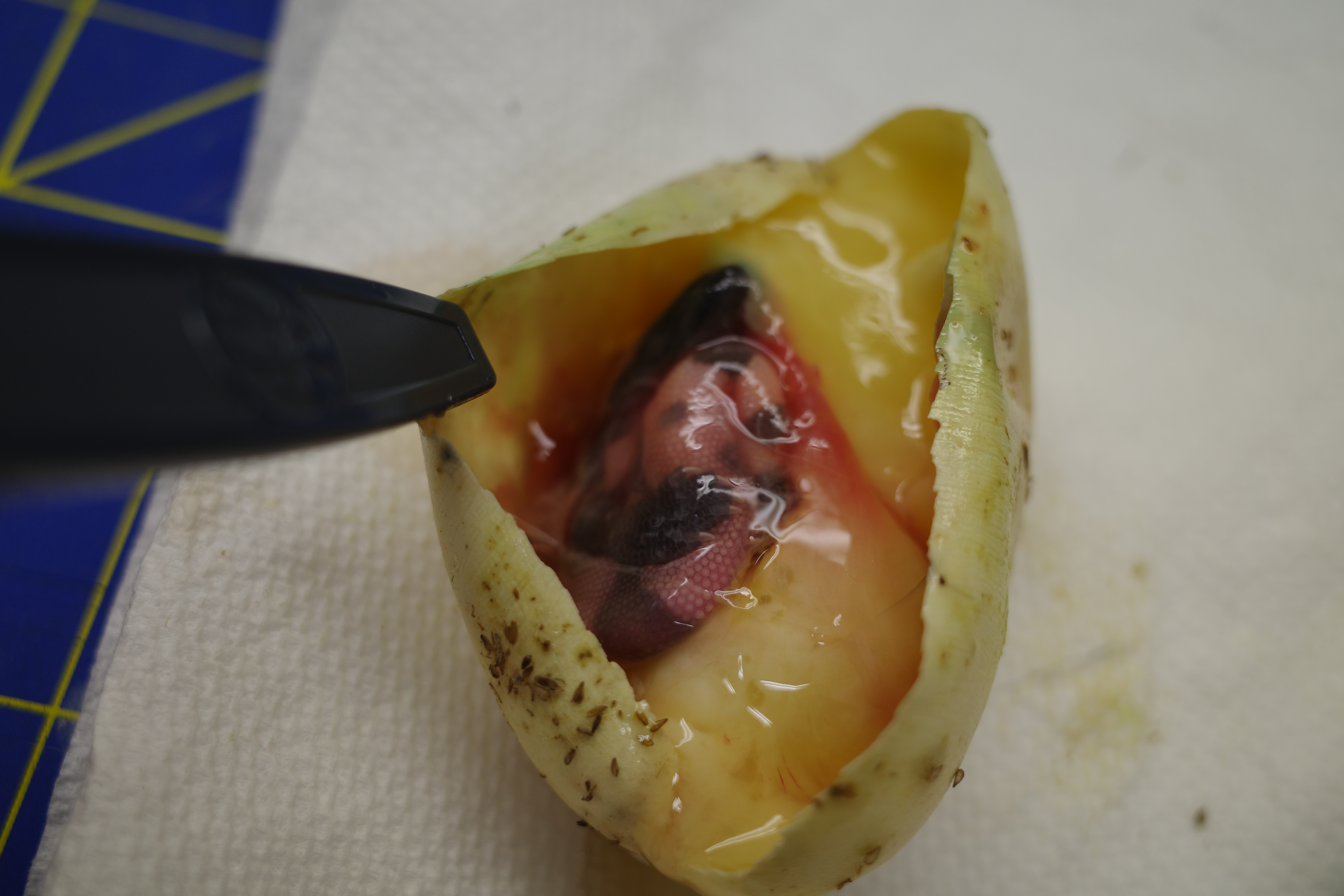
About a week or so ago, I noticed that Egg 10 was not looking so good. As only six eggs remained viable it is a hard hit when one is lost. I had kept it in the egg box in hopes it would turn around but after waiting a few days the egg started to sweat and smell so I candled it to see what was happening inside. No veins were present and there was a lot of clear yellow mass which was present in all the other eggs that died, so I knew it was no longer viable. Still hoping, I left it in the egg box for a few more days but it continued to deteriorate and smell so tonight it was removed.
After removing the egg I was morbidly curious to see what was going on, and how far the embryo had developed. Sadly, a fully-formed Gila monster was inside. It was much smaller than the typical hatchling but appeared normal overall. Why did this embryo die after being alive for so long? Has it been dead for a long time? It’s hard for me to say at this point with my limited knowledge, but I really hope that the other five eggs are healthy and hatch. Regardless of how this season turns out I am going to thoroughly review my notes and protocols and see where improvements can be made and where things may have gone wrong. At this point, my feeling is that the females were not prepared last year for this season. Maybe it was improper temperatures or not enough food but this year I know all my adults are in proper order and ready for next year. I’m not giving up on this season yet and still have hope that the five remaining eggs will sprout baby monsters in the next few weeks!




















 Goatsby's Place