As of today, only one pair of Gilas have been observed copulating. Mating activity usually picks up about now and lasts for 2-3 weeks, so more Gila monster love is sure to be seen. Though this is the only pair (Winston and Winifred) it is certainly the most exciting – if everything goes well and we get viable eggs from Winnie, it will be the first time that our axanthic line will have been produced.
Winnie was picked up in 2021 but had some health issues and the as held back for the first two years and allowed to focus on getting healthy, was off sync with follicle growth last year, and seems to be lined up this year. This axanthic project has been years in the making and I am certainly excited to see some babies come from this line! I’ll keep everyone posted on how the progress goes, I’m performing ultrasounds throughout the weeks and monitoring the pairs closely – fingers crossed for an amazing year!
While all was quiet on the blog and social media posts, we have been working diligently behind the scenes with our monsters, and are kicking off our 2024 Gila monster breeding season!
Misty, a high-orange female Gila monster produced here in 2019, will be bred with an unrelated bloodlines this year.
While every year is certainly exciting, 2024 is off the charts for us here at Goatsby’s Place! Besides the fact that our Seward-line axanthic female will be breeding for the first time, we also have two of our own Gilas also breeding for the first time! We will have a total of four females breeding this year, and four males to mate them with (a 1:1 ratio, which is preferred).
Winifred is our Seward-line axanthic female Gila monster.
As the season starts anew, it’s a time to reflect on past year’s successes and failures. I re-read my notes and chat with other breeders and try to see how we can do things better. This year’s focus will again be nesting in hopes of having more viable eggs laid on time. I’ve come up with a new nesting strategies and will be sure to share that here once we have it worked out. We’d also like to get more proficient with the ultrasound and be able to time ovulation and oviposition with greater accuracy this year.
A sight we hope to see mid-April!We monitor growing follicles and testes on our Gila monster by ultrasound. This helps us to keep an eye on reproductive development and when the highest chance of successful pairings are. Male testes also change throughout the year and need to be monitored.
Besides having the fortune to live with Gila monsters, its both profound and humbling to enter each year with these amazing reptiles and learn more about them. Having produced Gilas each year just feeds my love for them, and I’m sure this year will be no exception!
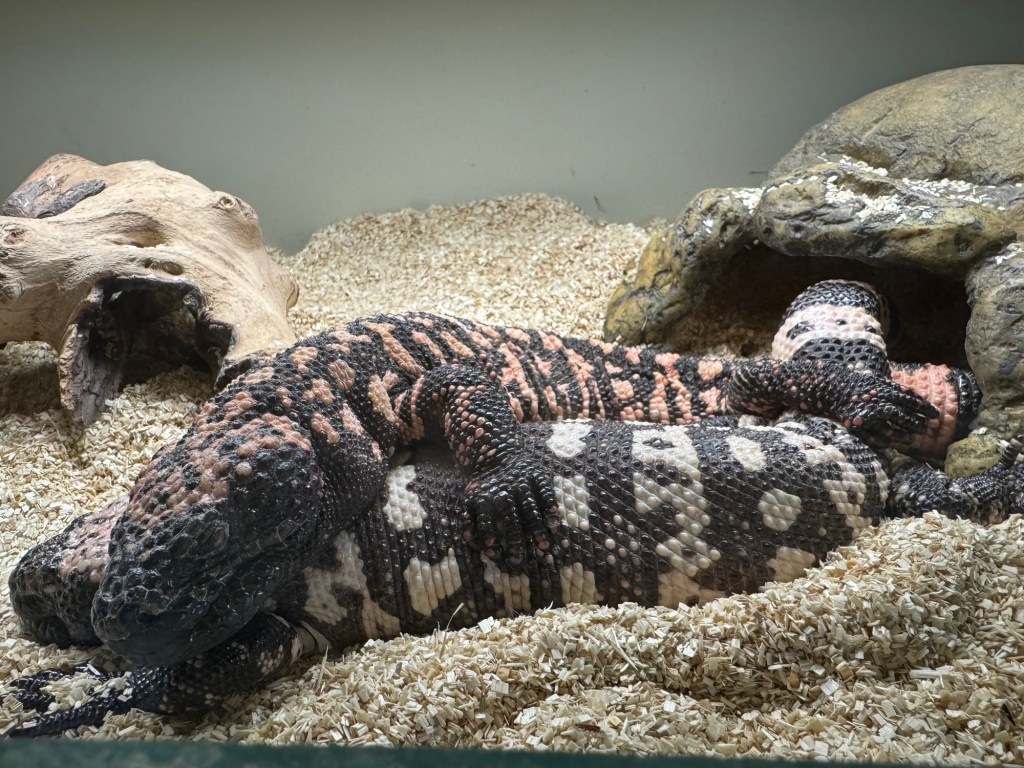
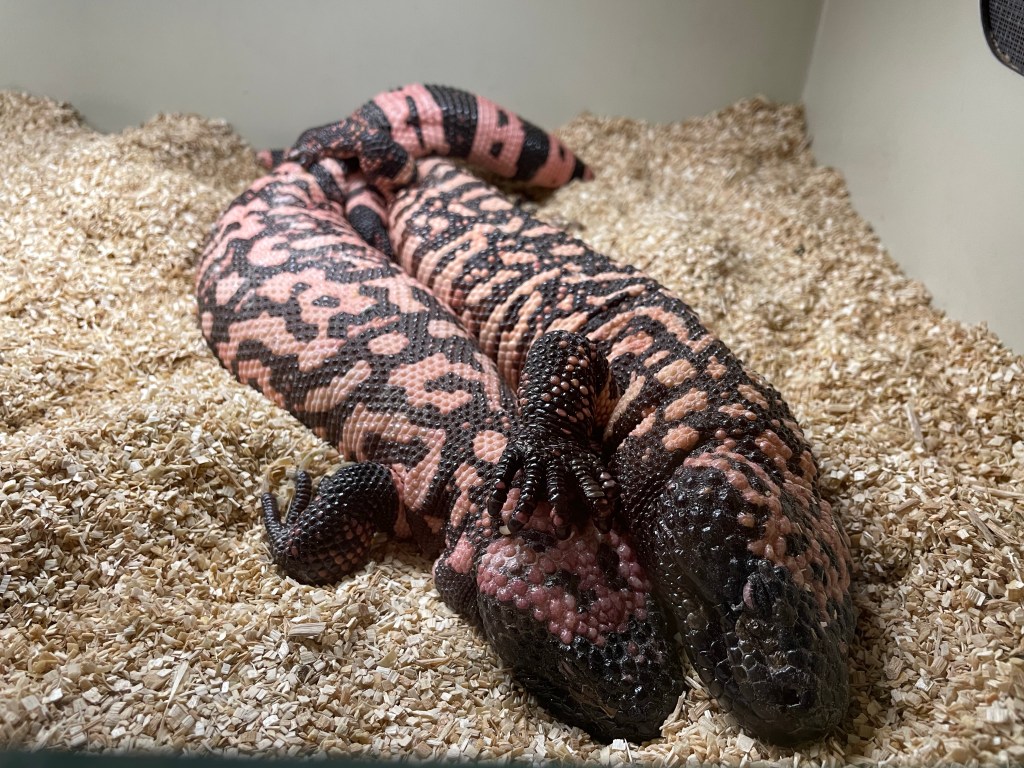
Gilas just wanna have fun!
Stay tuned for some exciting things happening at Goatsby’s Place this year, new videos, lots of photos, and of course more Gila monsters! If you’re interested in getting on our rapidly growing waitlist please email us today. And if you have any questions or there is something you’d like to see on an upcoming video please let us know. Thanks for stoping by!
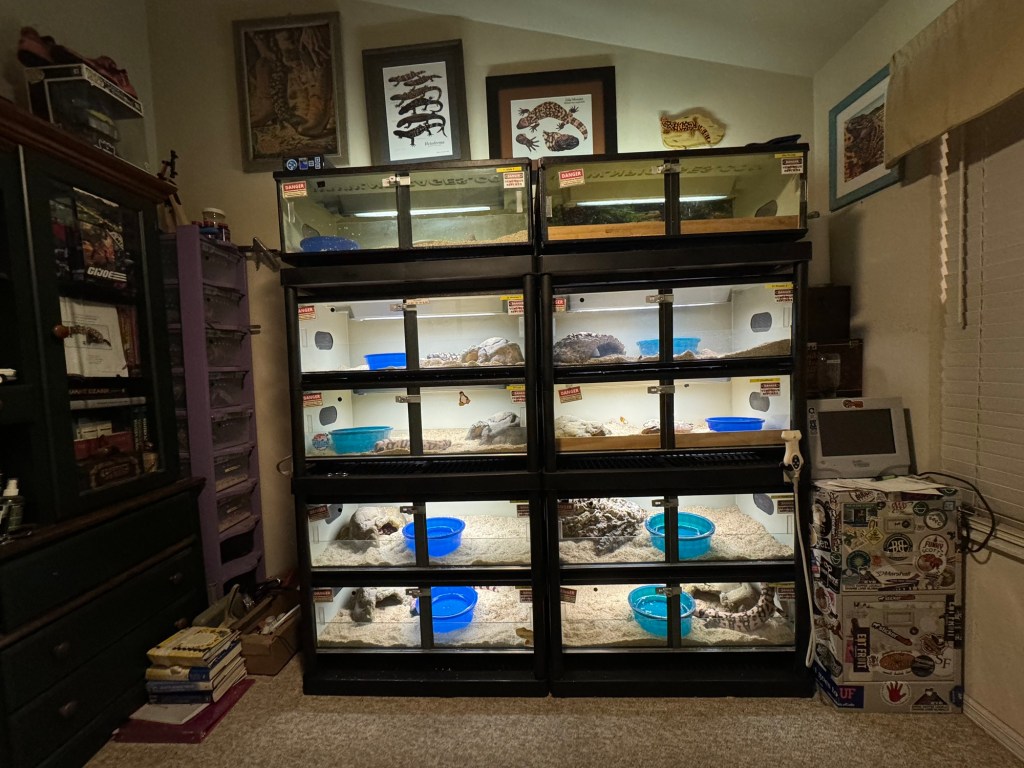
It’s been years since I’ve made any significant changes to my Gila room – some in part of there not being a real need and another part of good old fashioned laziness. But, after last year’s limited success and the driving need to do better and innovate (not to mention that my Neodesha NPI stackable cages were tilting ever forward like the Leaning Tower of Pisa) I got off my butt and went back to the drawing board.
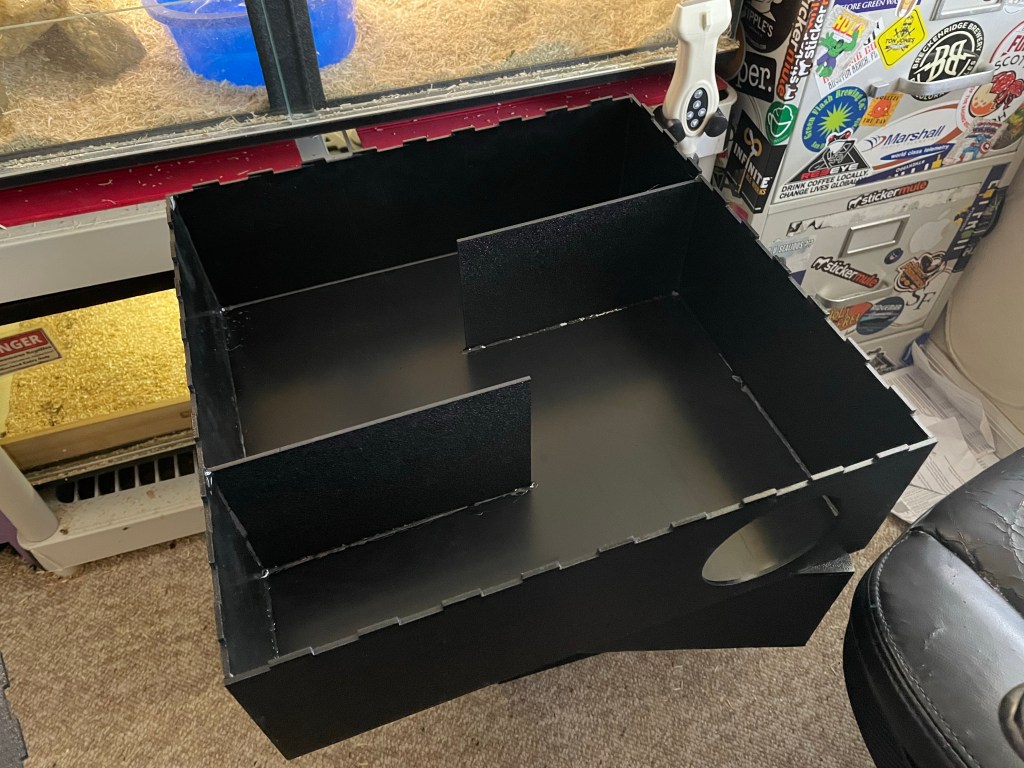
Thinking of where my shortcomings have been (nesting, still), the fact that these stackable cages have shown those Achilles heel, and taking inspiration from my Gila Amigo John’s “Gila Hilton”, the design objective was to have cages stacked two high for stability, interconnected laterally for male-to-female interactions, and with a separate nest box attached to the female side to encourage nesting. The design went through a few drafts but ultimately it came out like this..
See the big difference? That’s ok, neither do my wife or kids..😜
I’ve been pretty neglectful on updates including our 2023 offspring photos but I’ll get those up here soon. I’m very grateful and thankful of our followers and those that give our Gilas great new homes; the 2023 babies were sold out long before they hatched (pro tip: if you want dibs on a 2024-2025 baby NOW is the time to get on the waitlist)! With that being said, we are super excited for 2024! Our Gilas will be coming out of hibernation soon and the things get exciting quick. Stay tuned for updates and new videos, and of course great Gila monster content! Thanks for stopping by!
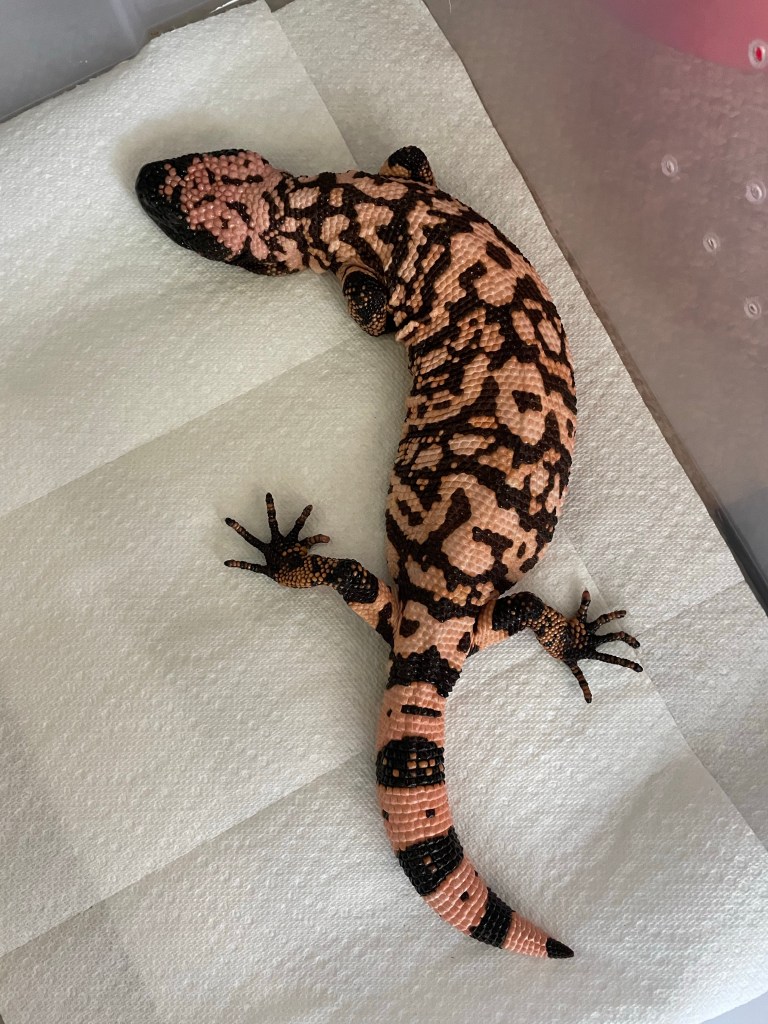
Misty wishing the giant eggs inside her would disappear. Note the sunken eyes and thin tail.
It’s been a while since I’ve posted or made a video, mostly because kids, work, and daily life keep me busy, but also because it’s been a tough year with the Gilas. It’s been hard to get excited with season that showed so much potential. Four females were being bred, including the axanthic Gila and one of my babies from 2019, new nest boxes were designed and created, and there was a record amount of coplulation observed. As of mid-May everything was going according to plan. There was a lot of observed copulation, the female Gila’s were utilizing their new nest boxes, and ultrasound showed growing follicles. So, where did it all go wrong?
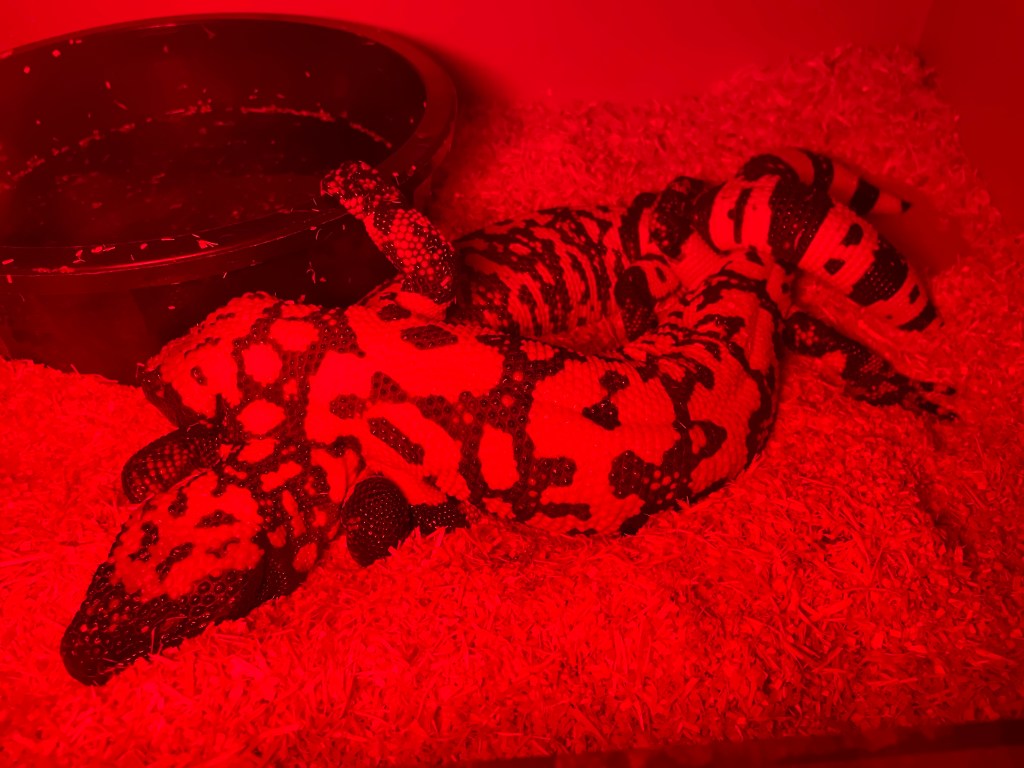
Red-light district, Gila style.
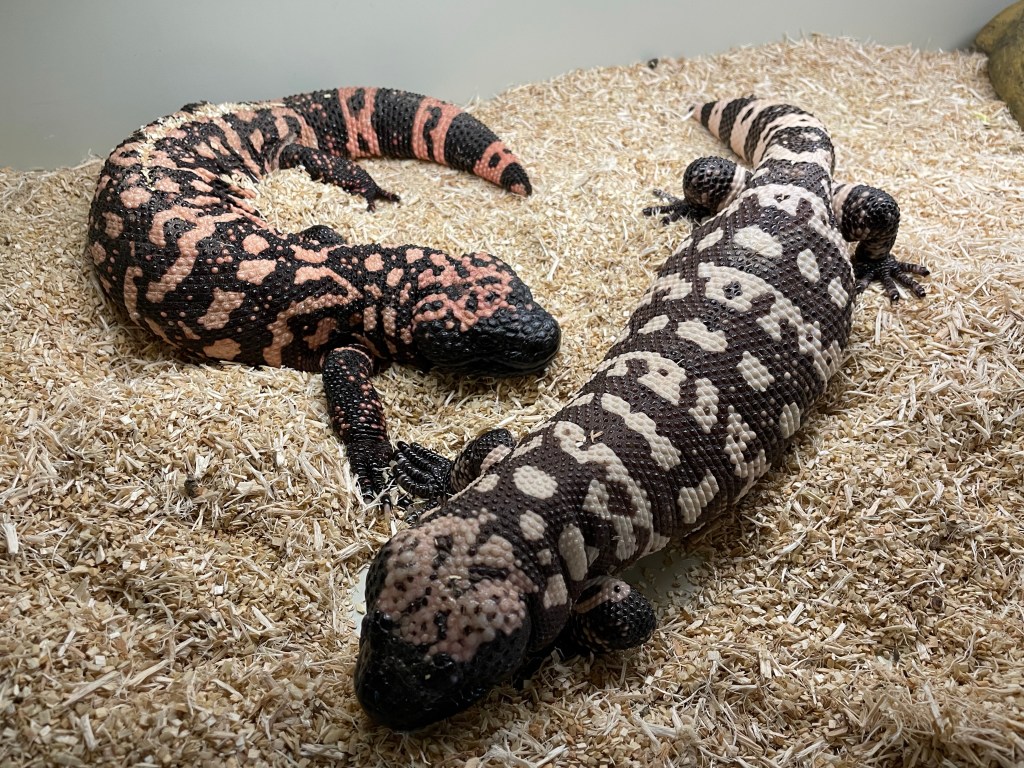
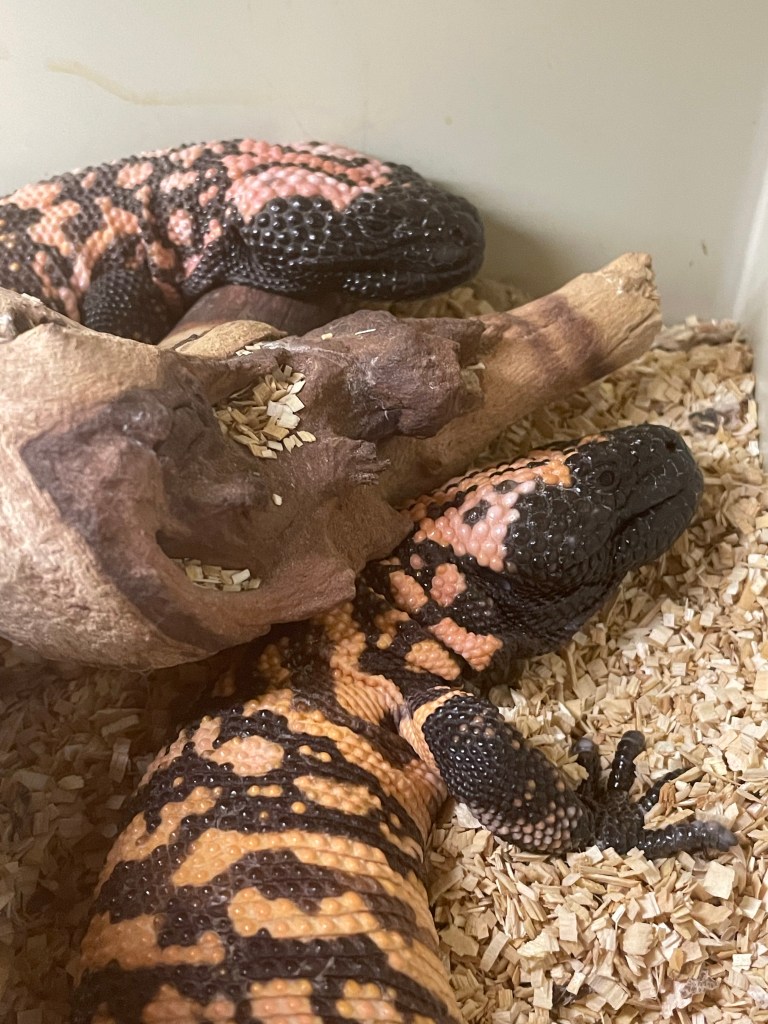
Pre-egg laying shed (or PELS as I call it).Winston and axanthic Winifred getting to know each other.
The first fly in the ointment was the axanthic female’s follicles were not maturing. Not at all. The axanthic Gila was not brumated in 2021 but was cooled in 2022 so her timing may be off, but only time will tell. Fingers crossed for next year.
Heather guarding her nest box very aggressively.
Next up was my nesting situation. I still think this is my biggest issue. I have no problem getting fertile eggs, and good eggs make it to term so my incubation technique must be working, but its the in-between nesting period that is getting me. So, this year I designed new nest boxes based on many hours of research and then custom-made for me by James at All American Cages. The boxes were chambered to allow the female to dig a suitable nest in privacy and fill it back in, but still allow me to check with a removable top. I put the boxes in the cages after the pairs were split in May and the females didn’t;t waste much time exploring the boxes and ultimately retiring to them for oviposition. Unfortunately the the females still laid late which, to me, caused some of the eggs to be infertile. I think I have a good idea what is going on and next year will prove my theory out, but it is likely the females must have complete quiet and secrecy to feel comfortable enough to deposit the eggs. How many wild nests have Gila researchers ever been able to find, in recorded history? One. Only one. And that was only found because a construction crew accidentally dug one up! For next year I am going to reimagine my set up. Not sure how yet but have a few ideas, stay tuned folks:)
My new nest box with chambers. Nest box filled in, mom on guard on the right!
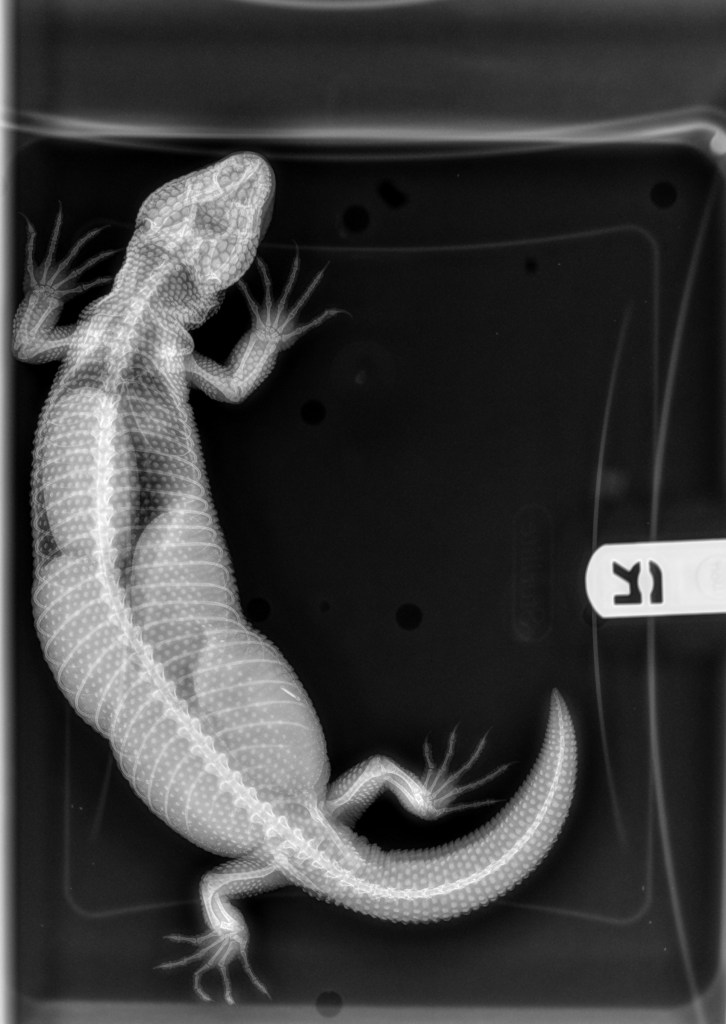
And last, but certainly not least, of this year’s woes was when my 2019 female Gila being bred for the first time got egg bound (or dystocia). My other females Gila lay early to mid-June like clockwork. Even when things aren’t going right the majority of the eggs are laid at this time (though a slug or two may come earlier or later), so when late June hit and Misty wasn’t laying I started getting worried. She started to lose even more weight than a normal female Gila does during the time of oviposition and still refused to eat, so early July I brought her to my vet to see what they thought. An X-ray showed five big beautiful eggs stuck in my little Gila and recommended removal by surgery at the University of Florida. While I had given the idea of waiting longer to see if she would lay some thought, anecdotal accounts universally gave bad prognosis for waiting too long – all cases I read either ended up with the female oviduct being removed altogether, or sadly in death of the Gila. Neither outcome seemed good tome so I did not want to wait any longer and scheduled the surgery the next day. I am very lucky to live in a college town with one of the country’s top veterinary schools (University of Florida, Go Gators!), but I also had the luck of getting one of the best reptile vets to perform the surgery (a big THANK YOU to Dr. Jim Wellehan and his team for the professional care and expertise on my dear Misty). Dr. Wellehan did his best to ensure Misty would be able to breed again, but only time will tell. At a minimum she will take next year off to recuperate but I will monitor follicle progress via ultrasound and see how things go. So far Misty is doing great, her incision wounds are healing well and she is eating like a champ!
X-ray showing five honking eggs in this female Gila monster. If you look closely at the egg nearest the head, you can see the heart and lungs pushed to the side! Eggs protruding from the belly, does not look comfortable!The day after surgery, looks painful but relief is on the way Misty!
To say that this year, which held so much promise, was a tough year is an understatement. As I always do after breeding season, my notes will be read and re-read, I will review ultrasound images and video, and think of how to improve next year. I have a few thoughts, mostly with nesting, but there may be some major changes coming up. Regardless, I still have good eggs in the incubator and any year that ends up with baby Gila monsters is a good one in my book!
Misty recovering well on paper towels. It was tough to lose the eggs but certainly worth it to save the girl!
It is absolutely the most exciting time of year here are Goatsby’s Place – baby hatching! After years of preparation and trying to get everything right, getting any Gila monsters to go full term is always an achievement. This year we had 15 eggs, and only four hatched so it was pretty rough but the four we hatched are exceptional! The Gila gods must have felt bad for me as they were nice enough to give me a dark-phase baby with no banding, a very rare morph indeed! Of course this little baby is staying with us to see how it turns out. We will be posting the photos of the babies soon, though we quickly sold out with the few we did produce so be sure to get on next year’s waiting list if you are interested in one of our monsters!
Hey Monster Squad! It’s been way too long since I last sent an update out which is disappointing as so much has happened since the last post. As with all Gila monster breeding seasons, this one was full of surprises and a lot of lessons to be learned.
Caught in the act.Well, we know what this is..Locked up at night.
First, during pairing and copulating we attempted a 1.1 ratio for breeding pairs which we hoped would increase success. Two of our previously bred females were seen copulating at least five times, but the new girl we got last year was only seen once. Eggs seem to be maturing well as monitored on ultrasound, except for the new female which only had two eggs (the other two females had greater than five eggs from what we could see). By the time egg laying came about in June this is where things change and deficiencies in our program were found. our two long-term females produce 13 eggs between the two of them, and the new girl produced two.
Egg forming from follicle as seen by ultrasound. Egg at a later stage, the shell now visible on ultrasound. Momma monster made a nest for her tightly buried eggs and guarded the nest for over two weeks!
Unfortunately only four of the 15 eggs survived of the whole group to date. One was actually eaten by it mother! This was a severe disappointment but valuable lessons were learned. First, the new female was under condition and not ready to be bred but she had enough weight and we thought she would be ready, she was not. Second our egg-laying protocol needs to be revised as it appears our girls are not comfortable laying eggs in their current egg boxes, which at this time are the entire cage turned into an egg laying nest with dark tint over the glass to provide privacy. Unfortunately this is not enough and we are going to try something entirely new next year fingers crossed!
Inside the nest above, six Gila monster eggs!Bad eggs and good eggs, wish I had Willy Wonka’s machine to save some time.
As we approach the end of October we have four eggs still in the running. Four out of 15 is not a good ratio but some success is certainly better than none at all! It’s interesting that most eggs go bad within the first 30 days of laying, which says to me that our incubation protocol technique is working. Of course mid and late term and losses have happened but generally most eggs even fertile they are doomed will go bad within the first 30 days. These days I’m checking the incubator daily opening to egg boxes for fresh air as the humidity and temperature continue to remain stable throughout the week incubation period. We are super excited for the birth of our baby Gila monsters – each time I truly feel like a kid during Christmas opening the big gift center left under the tree! As soon as the babies are out we will post pictures and contact those on the waitlist in the order that they joined (Allen you’re up first!).
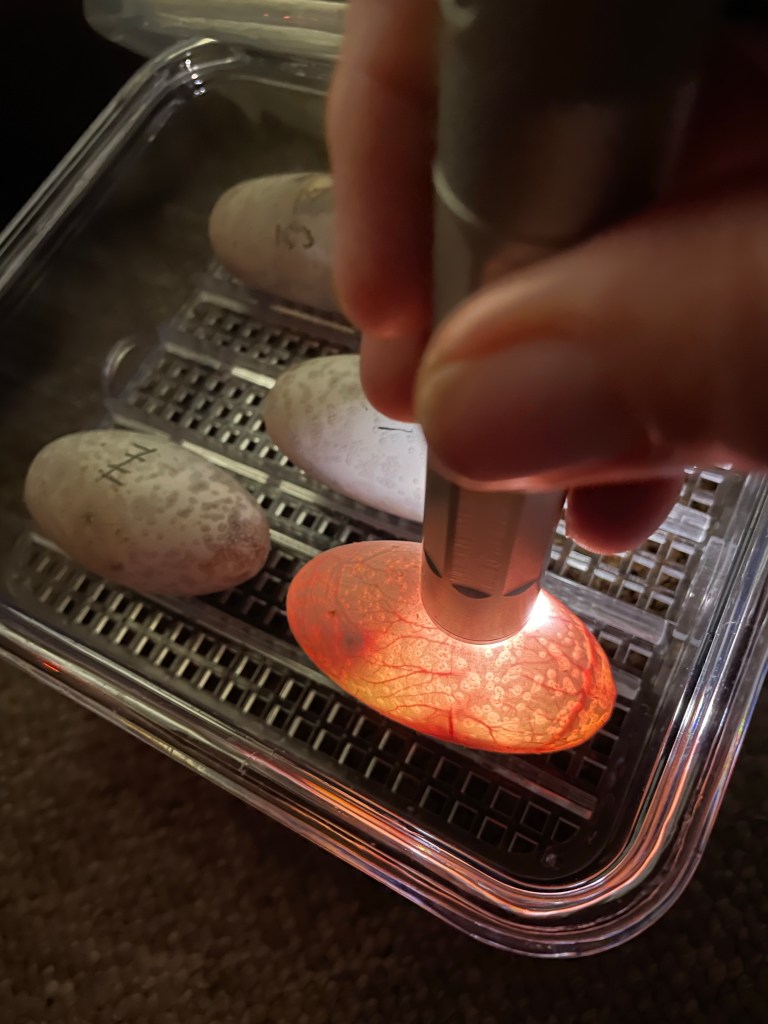
Late-season candling of a viable egg showing nicely growing veins.
So as we wrap up our 2022 Gila monster breeding season and get our monsters ready for the Big Chill (hibernation, not the movie), we look forward to an amazing 2023 breeding season. One of our 2019 females produced here is growing follicles as shown by ultrasound and will be attempted to be bred next year. We are also very excited to have our axanthic Gila monster Winnie up to condition and ready to breed next year. This is a very, very exciting project for us as few of these morph are being bred throughout the world. We are also excited to put into motion the lessons we learned in this and past seasons to improve our success and to see more amazing baby Gila monsters born into this world, because what world isn’t better with more Gila monsters in it?
Winnie, our axthanic Gila, looking to be in good condition
Kicking off the 2022 Gila monster breeding season seemed like a time to start our YouTube videos. We plan on documenting the entire breeding season, from warm up to hatching babies, to help expand the knowledge of breeding Gila monsters in captivity. Check it out here and let us know what you think!
Winnie the monochromatic (axanthic) Gila monster wasn’t quite ready for the 2022 breeding season despite being six years old but we look forward to her joining the group in 2023.
Our 2022 Gila monster breeding season is about to kick into high gear. Our group (or lounge of Gilas as it’s known) of adults will be coming out of brumation soon and the captive breeding season begins. But all’s not been quite as our monsters sleep here at Goatsby’s Place, quite to the contrary as we’ve worked hard to prepare for this season and improve on what we’ve learned over the past year’s successes and failures.
Our 2020 holdbacks aren’t ready to breed so do not get brumated during the winter until they are a few years old.
Our primary goal this year (other than to have fun and raise amazing baby Gila monsters!) to increase our hatch rate to 80% or better. Over the past few seasons are hatch rate has been 50% or less which is disappointing to say the least but I have some ideas as to why our success has been limited. This year will be the first time we can test these theories and prove them out. Last year‘s phorid fly attack and the fact that only one male was cooled certainly contributed to the lack of success. This year on the other hand we have equal ratio adult pairs and are working with our own ultrasound to closely follow the inner workings of the male and female reproductive systems.
Ultrasounding a very patient Gila monster. Photo by J. Brueggen
On a technological front we are migrating to a fully web-based system to monitor and adjust things as the season progresses. We’ve purchased and implemented the über-cool Spyder Robotics Herpstat SpyderWeb proportional thermostats to control the heat, and importantly, set up a nighttime temperature drop for the Gilas. We continue to use the SensorPush system to monitor ambient temperature and relative humidity, and added night vision cameras to monitor copulation and activity between paired Gilas. Having all this work with Alexa is just a geeky bonus, but fun nonetheless.
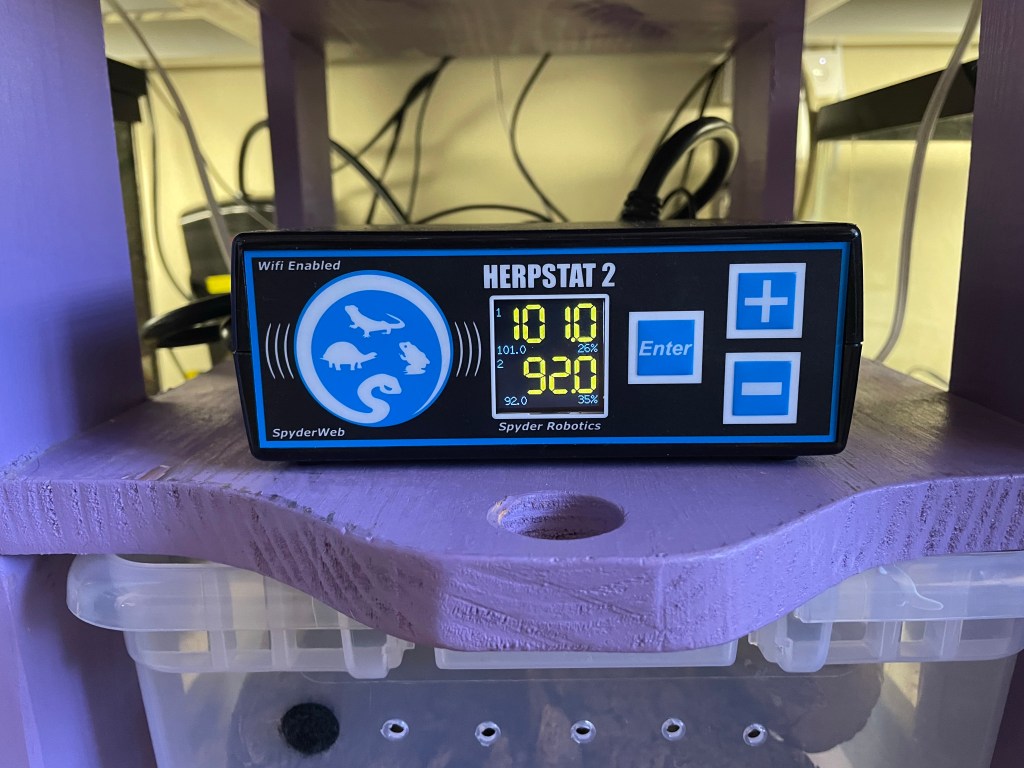
Herpstat 2 SpyderWeb proportional thermostat is a web-based unit that can be checked and adjusted from anywhere!
And last but certainly not least, keep an eye out on our YouTube channel as we begin a series of videos documenting the full reproductive season of our Gila monsters, from pairing, to copulation, to egg-laying and incubation, and if all goes well, hatching. My goal is to produce informative and fun videos to help increase our understanding of the amazing Gila monster. The good news is you get to see lots of beautiful Gila monsters, the bad news is you’ll get to see my ugly face from time to time:)















 Goatsby's Place