The anticipation is killing me. So close to hatch time for our 2025 Gila monster babies it’s hard not to check multiple times a day! with this years pairings it will be a very interesting year to see what pops out! Hopefully some high pink reduced pattern Gilas pop out, but no matter what they’ll be beautiful baby Gilas to enjoy! Stay tuned!
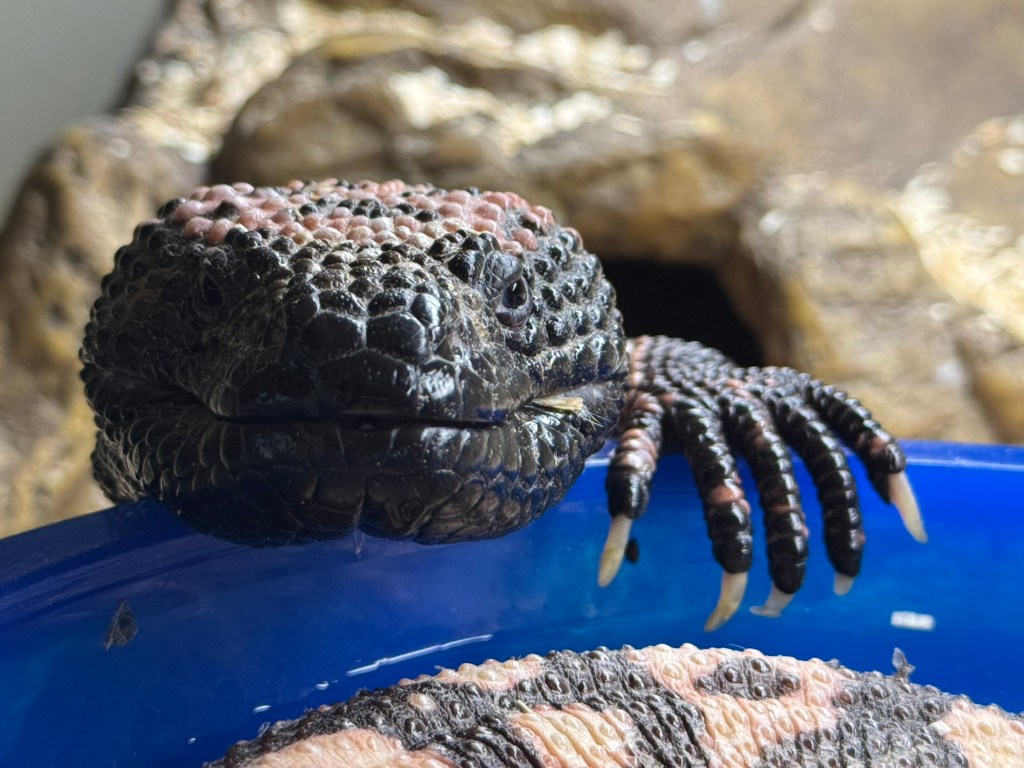
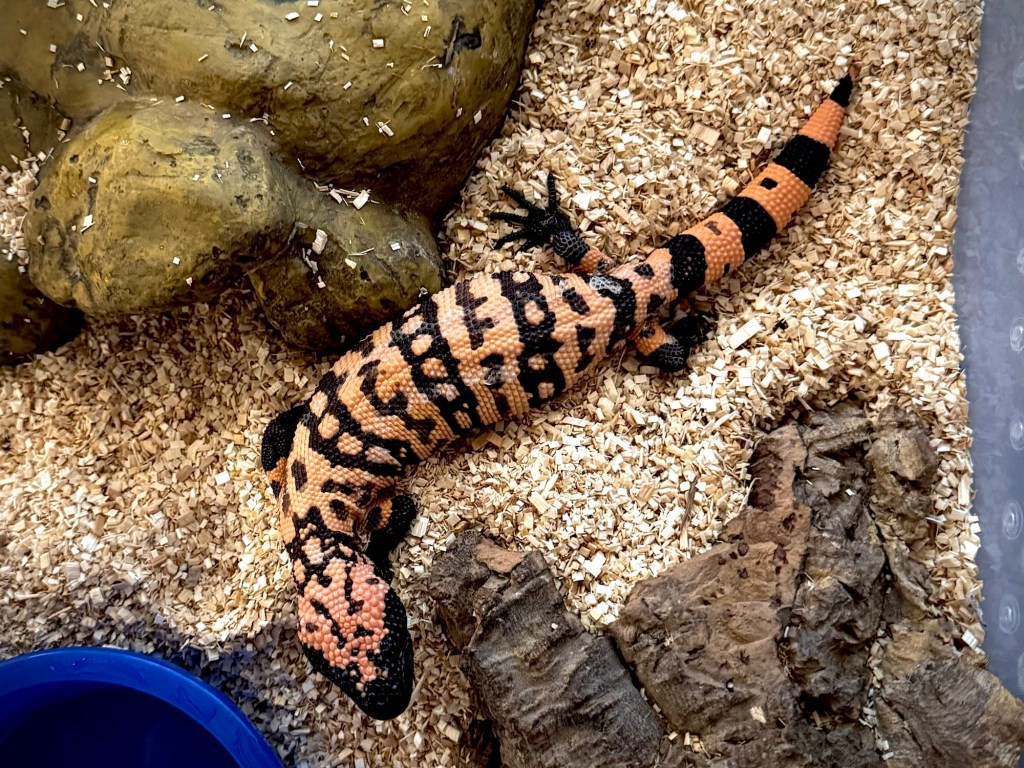
Our 2024 holdback is getting more beautiful with age!
Gila monster breeding is not a black and white endeavor.
As with every Gila monster captive breeding season, there are wins and loses, new things learned and insights gleaned to improve next year.
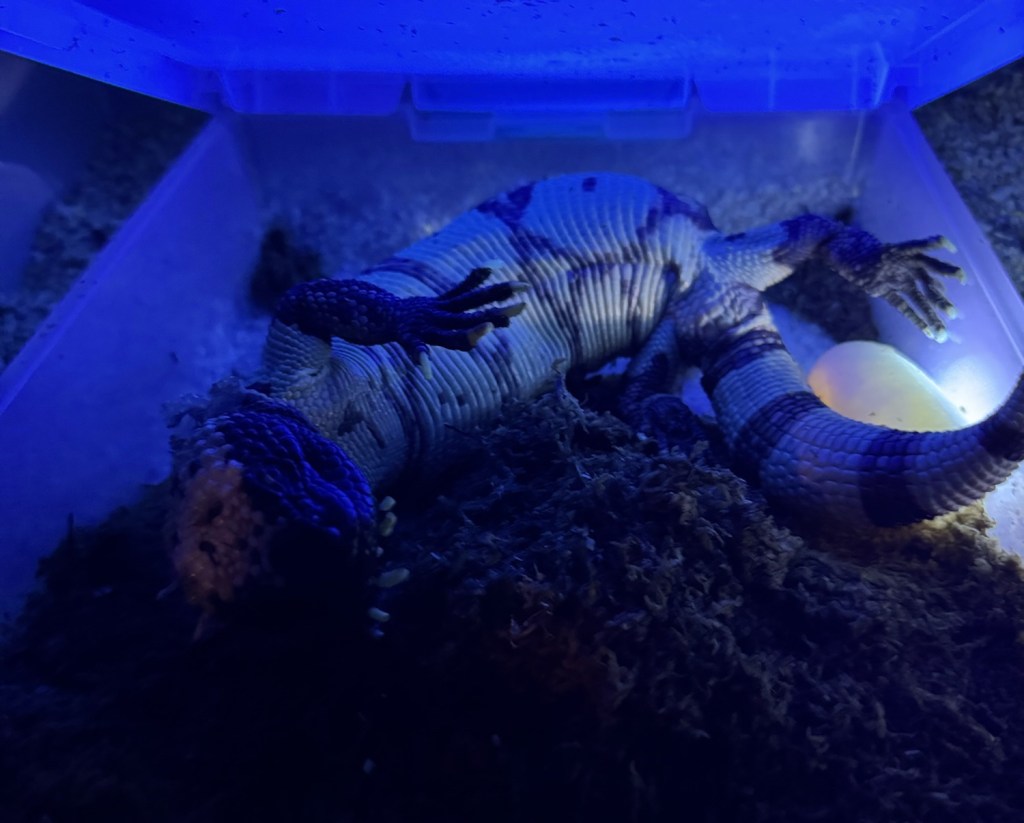
Is that a xenomorph in deep space laying its deadly eggs? No it’s just our banded Gila monster Lucy resting between laying much less dangerous eggs. No facehuggers here thankfully.
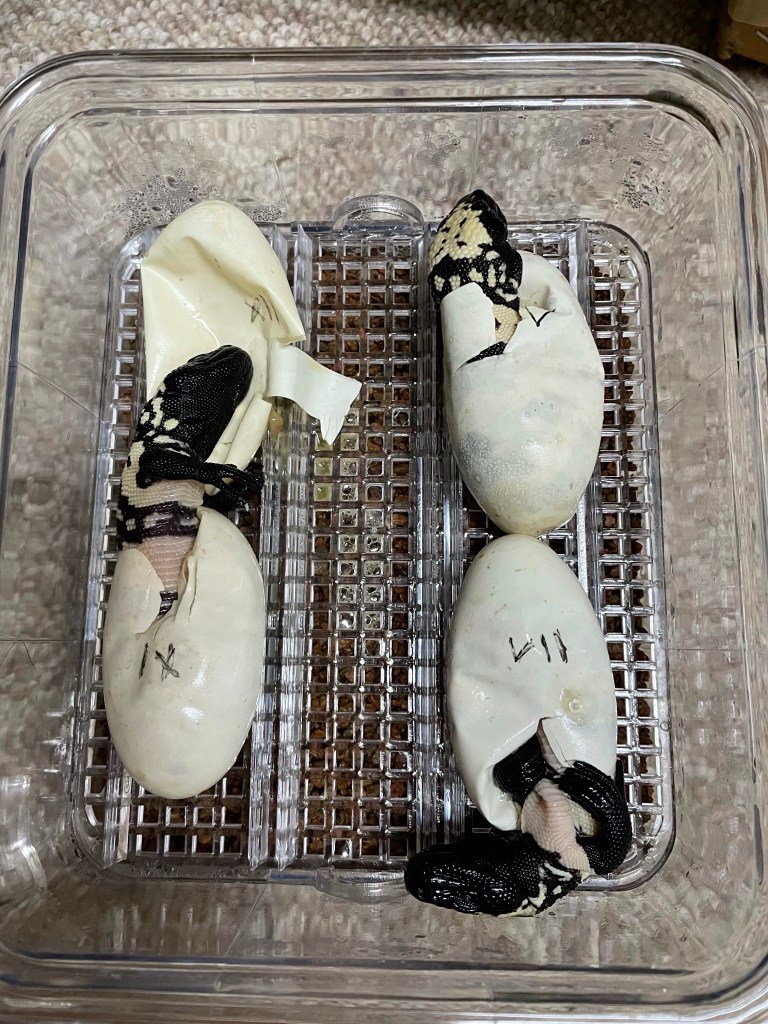
First the wins; I had an improved nesting experience (thanks to my mentor Dr. Mark Seward) with my stalwart females Belle and Heather who had their best year yet. The newbie females are still figuring it out and they laid partial clutches which are good, but held eggs that were ultimately unviable. Also, we had a disproportionate ratio of males to females so had to do some calculated male swapping so that likely factored into things. The females are also recovering nicely post breeding which bodes well for next year. I currently have ten good eggs in the trusty Grumbach S84 incubator which is great. There was a total of 22 eggs, 10 of which were infertile slugs or laid late, 2 fertile eggs went bad about a month after being laid, and 10 still a-cookin’. I always feel that if I have one egg hatch in a season it’s a win!
The losses are always rough, especially when you lose a Gila and this year we lost a female that became egg bound. It is tough and in retrospect I should have intervened sooner, but assumed that since she was eating and defecating the eggs would have eventually passed on their own. Sadly, this was not the case. It seems the time between oviposition and expiration is much shorter than anticipated and generally experienced with other reptiles. Now I know not to wait and to intervene sooner, but I am deeply saddened that this information came at the cost of a beautiful Gila monster.
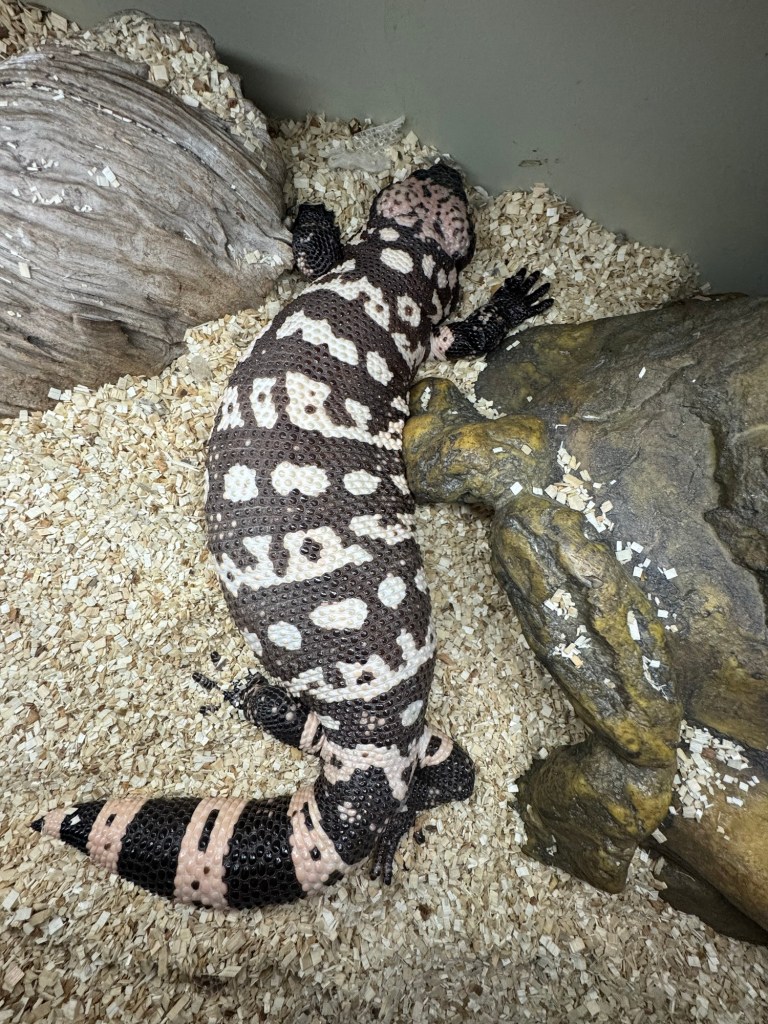
Winnie, full of eggs and hope..
Another battle that is ongoing is with our axanthic Gila monster Winnie that has refused to eat after laying five infertile eggs. She has been to the vet and is on antibiotics, but she is still not eating voluntarily. Not a good sign but she is eating eggs with a little help from me and I am hoping she recovers. As it’s late in the season and she should be bulking up not fighting for her life, Winnie will be taking the next year to recover as long as she pulls through. She was sick when she arrived in 2021 and after treatment then she has had been doing well until now. There’s obviously an underlying issue that we will get to the bottom of over the next year to ensure she gets healthy and stays healthy for the rest of her days. Stayed tuned for updates on this front…
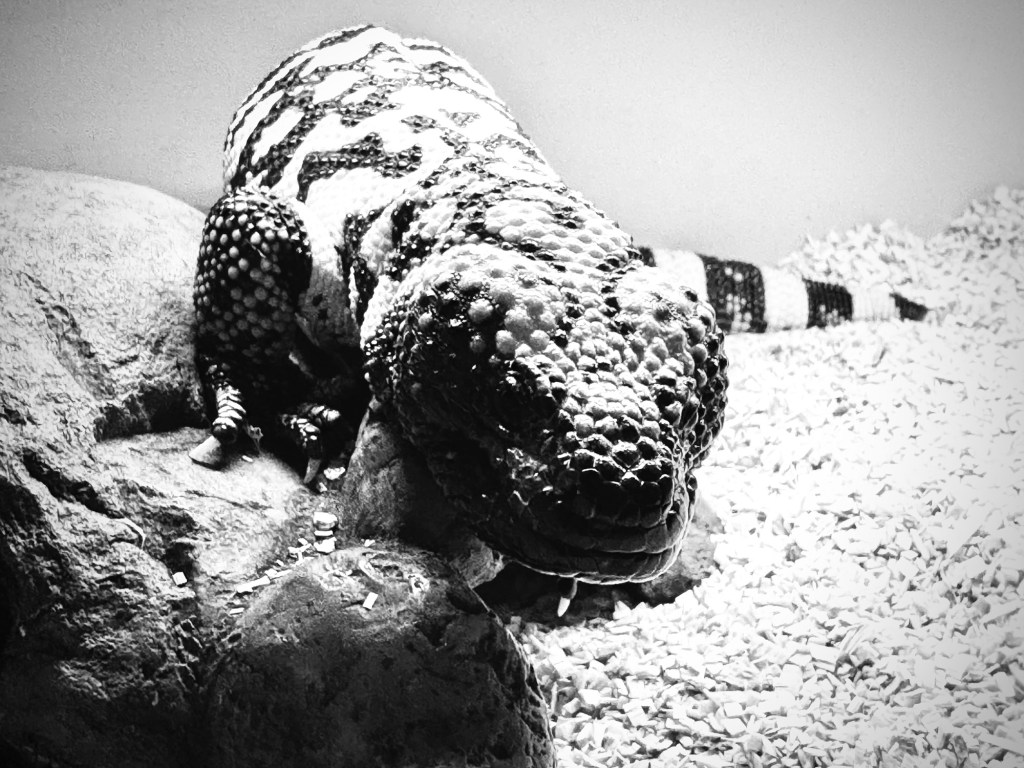
Last year’s holdback continues to blow me away as she grows with a deepening orange and dark black coloration.
So, it’s been another year of learning, living and loving our precious Gila monsters. Keeping detailed notes is helping to make changes in the future which will lead to greater success and hopefully no more losses. I can’t wait to see what pips out of the egg this year, it truly makes all the struggles and planning worth it when the babies come out!
PS – My 10-year-old daughter is creating videos for Goatsby’s Place, so they’ll be some fun shorts on YouTube coming up soon!
The pairs have been paired and soon we get to see how things went. I’ve been doing this long enough not to expect miracles, but I must admit to being a little more than excited about having six females, including our axanthic, potentially laying eggs this year. It is always a bit like Christmas morning when you’re a kid waiting for Gila monster eggs, you’re not quite sure what you’re going to get, but you hope it will be everything you’ve dreamed of all year. All the planning, cooling, feeding, and pairing comes to fruition or failure now.
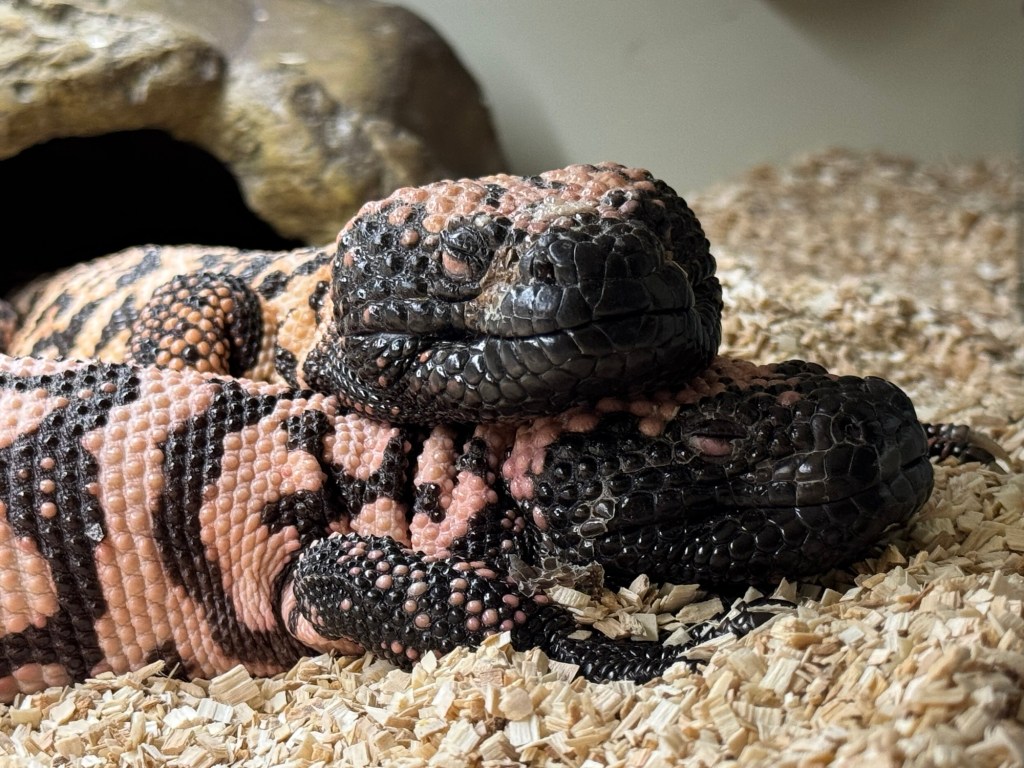
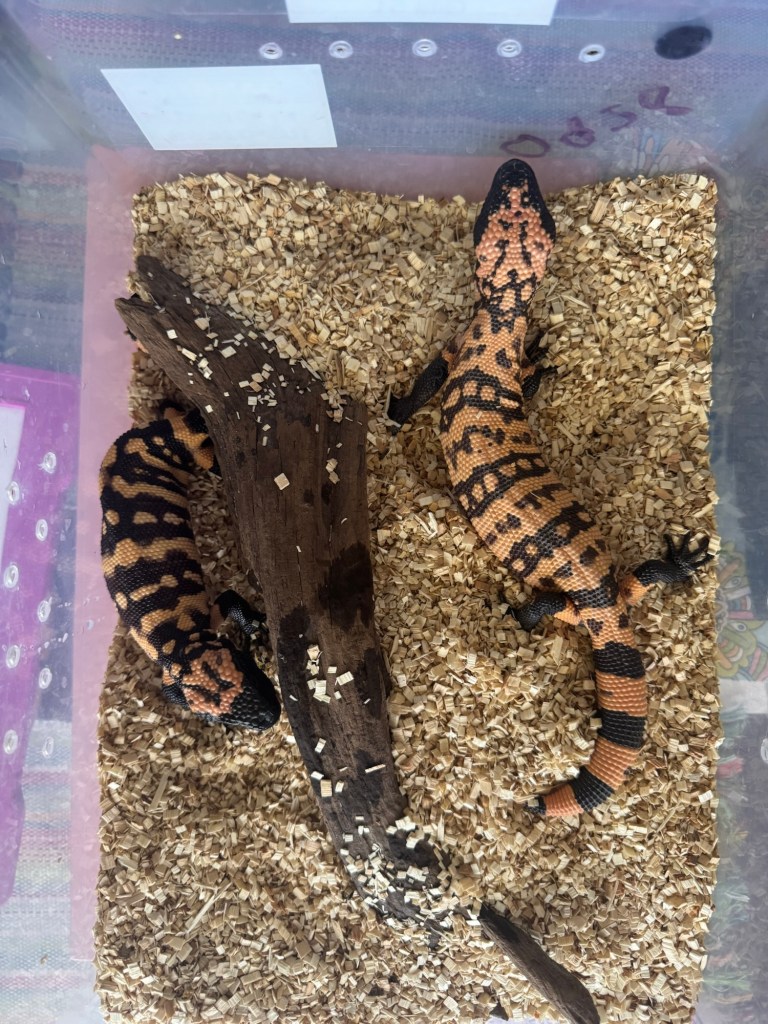
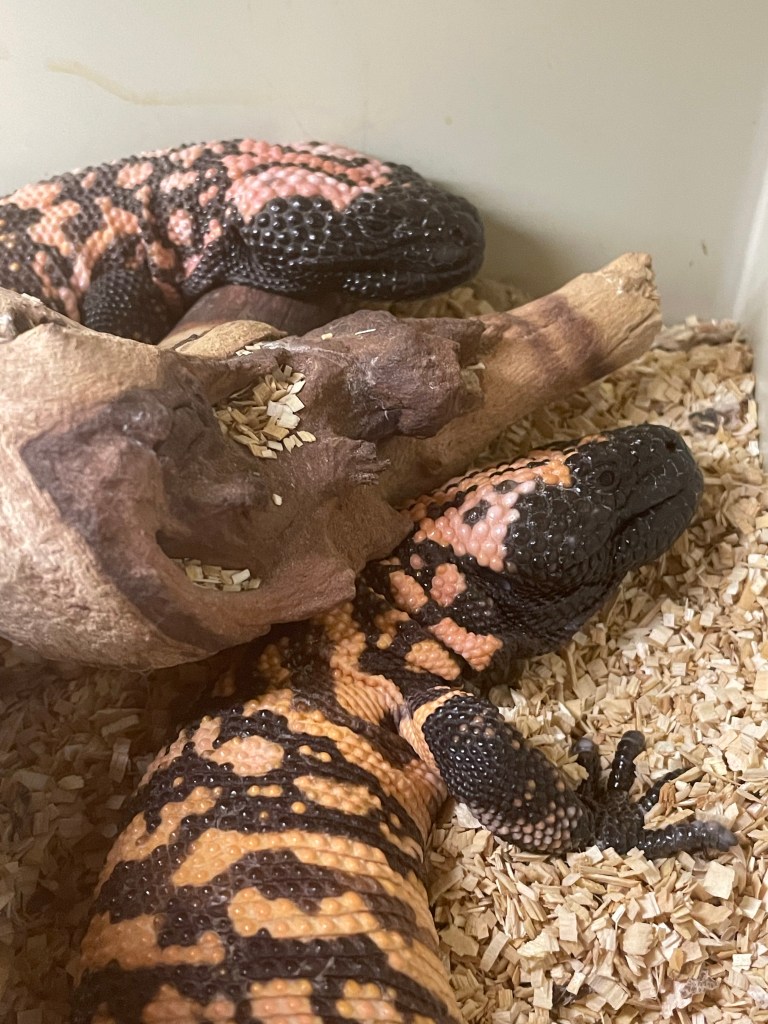
The Gilas get very close throughout the season.
Setting up the pairs in hopes of achieving specific traits such as high pink or orange, reduced or abnormal patterns, or axanthic, is meticulously planned based on babies that have been produced here. I am in touch with many of the folks that have purchased Gilas from us here at Goatsby’s Place and track how they grow to try and replicate these traits. The axanthic line, originally from Seward’s project, is very exciting and we hope to have some 100% hets this year from that pairing.
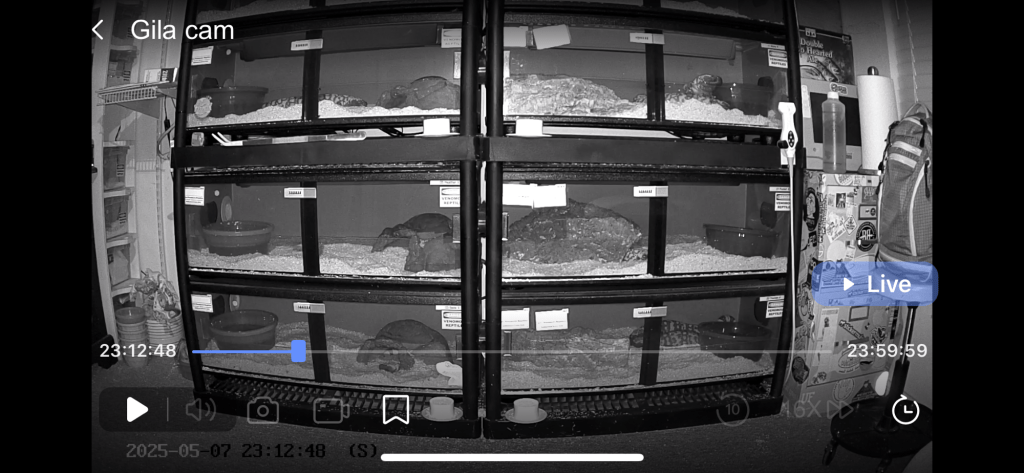
Smile you’re on Candid Camera! Pairs are watched and recorded throughout the day and night for mating activity.
After oviposition the long wait begins. It’s been common for eggs that will not make it to term to expire within the first 30 days after being laid, though they can go bad at any time really. Never count your Gilas before they hatch is a good analogy! There’s a lot of hurry up wait at this point but it’s all part of the process in breeding Gila monsters.
Winnie the axanthic Gila laying out of her shelter.
Every year starts out with hope and we are thankful that it has ended with baby Gila monsters for the past six years. Some eggs are not fertile or make it to full term, but as long a a baby Gila pips its head out of the egg in the fall it is all worth it!
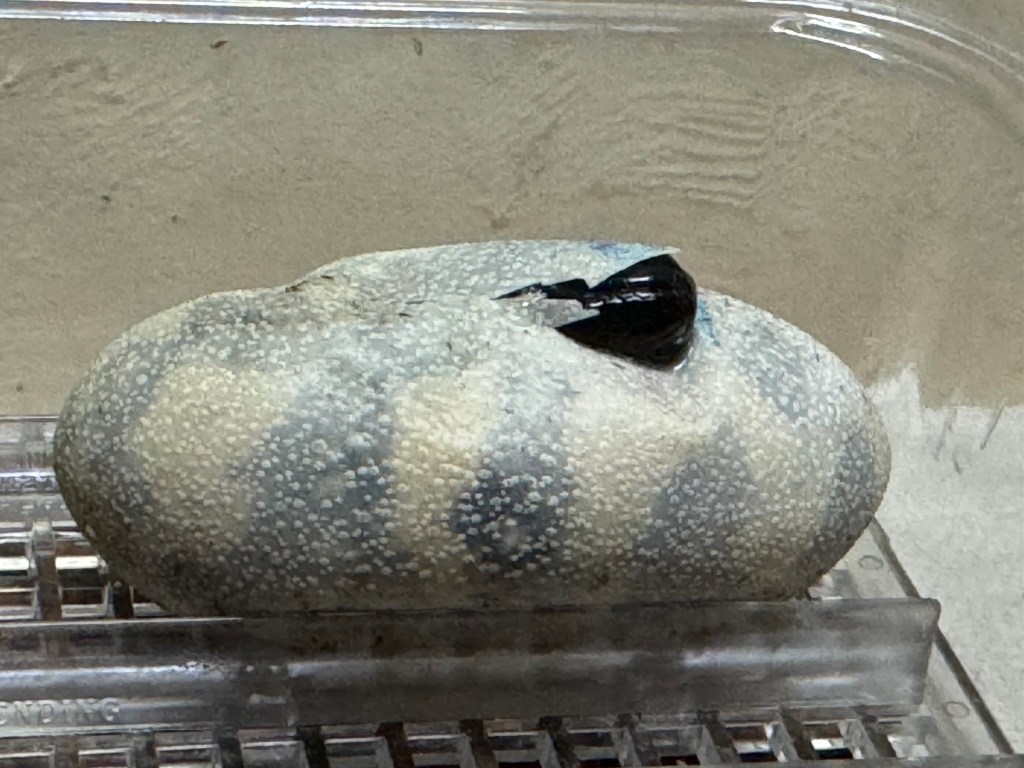
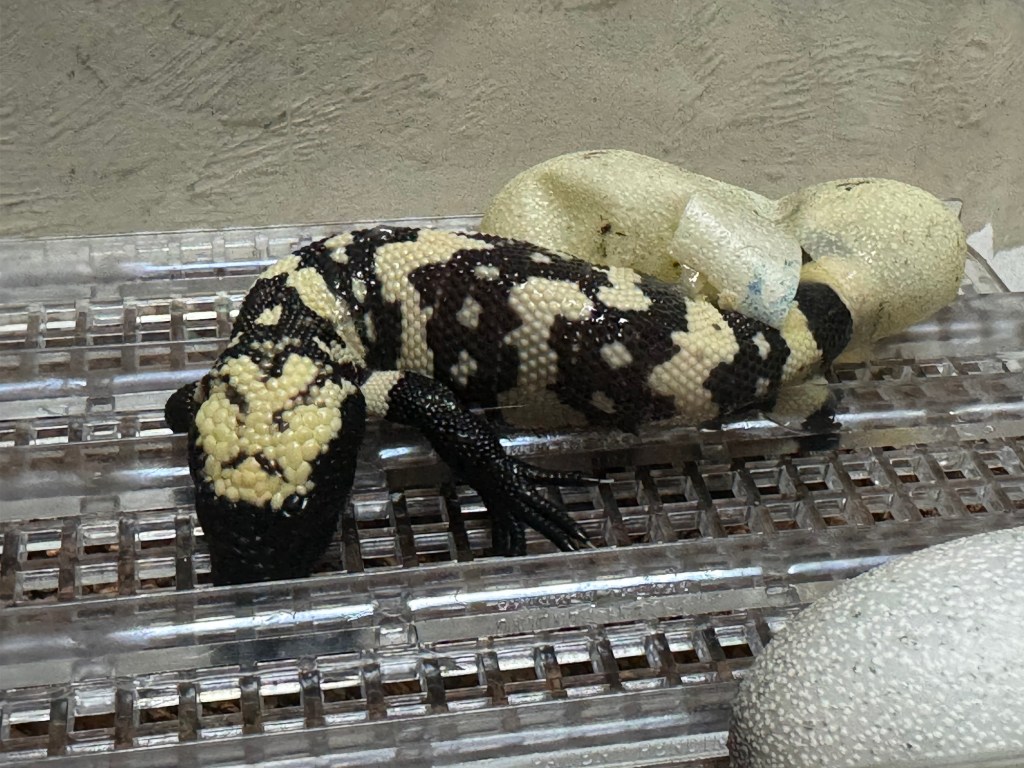
This never gets old. Say hi to the world’s youngest Gila monster!
As our Gilas hatch those on the waitlist will be contacted in the order joined. We only had four eggs this year, so availability is very limited but let us know if you want to get in the list for 2025. Or, just reach out to talk Gilas!
Winnie the monochromatic (axanthic) Gila monster wasn’t quite ready for the 2022 breeding season despite being six years old but we look forward to her joining the group in 2023.
Our 2022 Gila monster breeding season is about to kick into high gear. Our group (or lounge of Gilas as it’s known) of adults will be coming out of brumation soon and the captive breeding season begins. But all’s not been quite as our monsters sleep here at Goatsby’s Place, quite to the contrary as we’ve worked hard to prepare for this season and improve on what we’ve learned over the past year’s successes and failures.
Our 2020 holdbacks aren’t ready to breed so do not get brumated during the winter until they are a few years old.
Our primary goal this year (other than to have fun and raise amazing baby Gila monsters!) to increase our hatch rate to 80% or better. Over the past few seasons are hatch rate has been 50% or less which is disappointing to say the least but I have some ideas as to why our success has been limited. This year will be the first time we can test these theories and prove them out. Last year‘s phorid fly attack and the fact that only one male was cooled certainly contributed to the lack of success. This year on the other hand we have equal ratio adult pairs and are working with our own ultrasound to closely follow the inner workings of the male and female reproductive systems.
Ultrasounding a very patient Gila monster. Photo by J. Brueggen
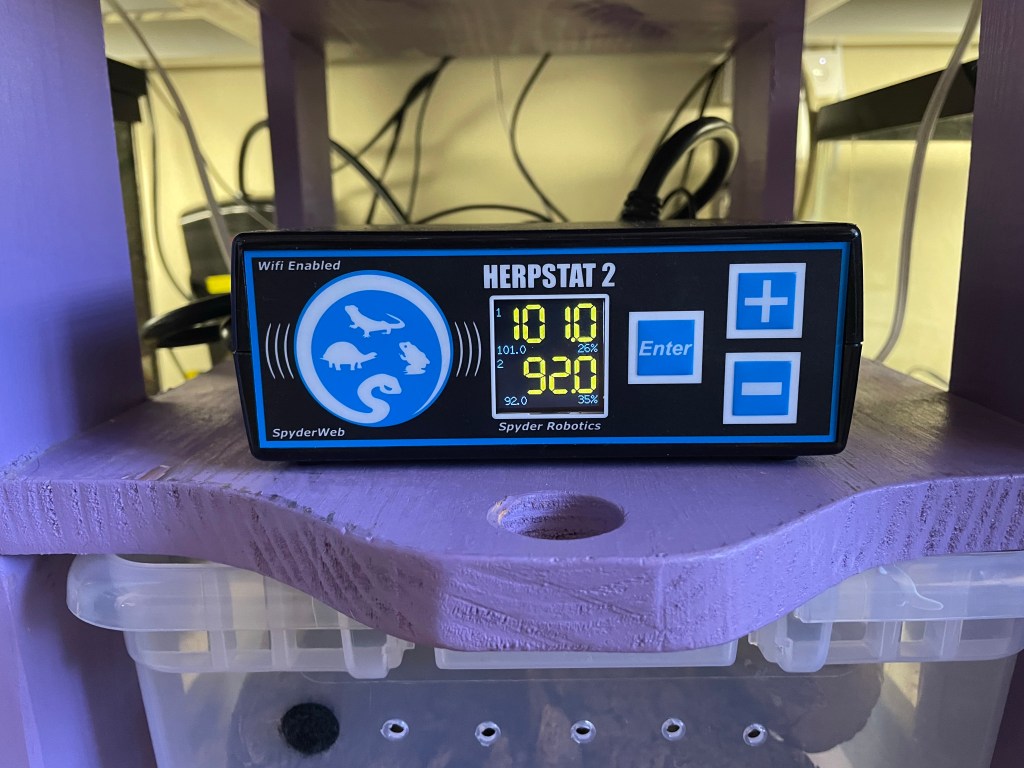
On a technological front we are migrating to a fully web-based system to monitor and adjust things as the season progresses. We’ve purchased and implemented the über-cool Spyder Robotics Herpstat SpyderWeb proportional thermostats to control the heat, and importantly, set up a nighttime temperature drop for the Gilas. We continue to use the SensorPush system to monitor ambient temperature and relative humidity, and added night vision cameras to monitor copulation and activity between paired Gilas. Having all this work with Alexa is just a geeky bonus, but fun nonetheless.
Herpstat 2 SpyderWeb proportional thermostat is a web-based unit that can be checked and adjusted from anywhere!
And last but certainly not least, keep an eye out on our YouTube channel as we begin a series of videos documenting the full reproductive season of our Gila monsters, from pairing, to copulation, to egg-laying and incubation, and if all goes well, hatching. My goal is to produce informative and fun videos to help increase our understanding of the amazing Gila monster. The good news is you get to see lots of beautiful Gila monsters, the bad news is you’ll get to see my ugly face from time to time:)
The 2021 baby Gila monsters are all out and settling in here at Goatsby’s Place! We are very proud of our beautiful baby monsters, and feel blessed to have been successful again this year. While most are spoken for, we may have a few available for new homes. Please email us if interested, or to get on the list for 2022.
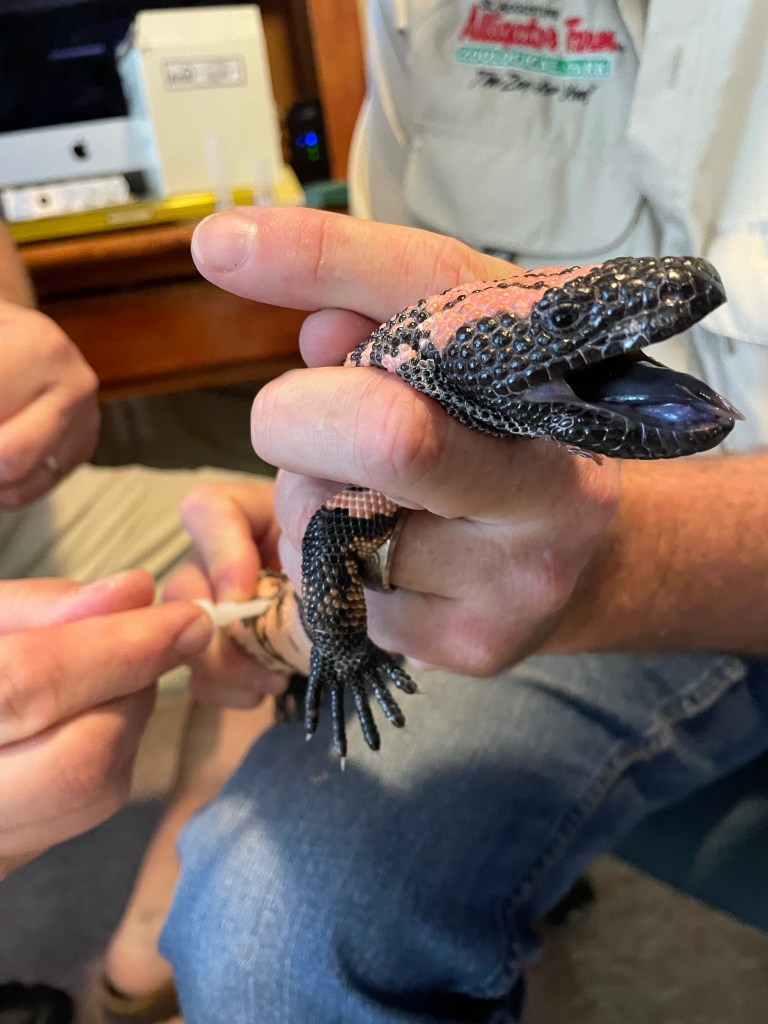
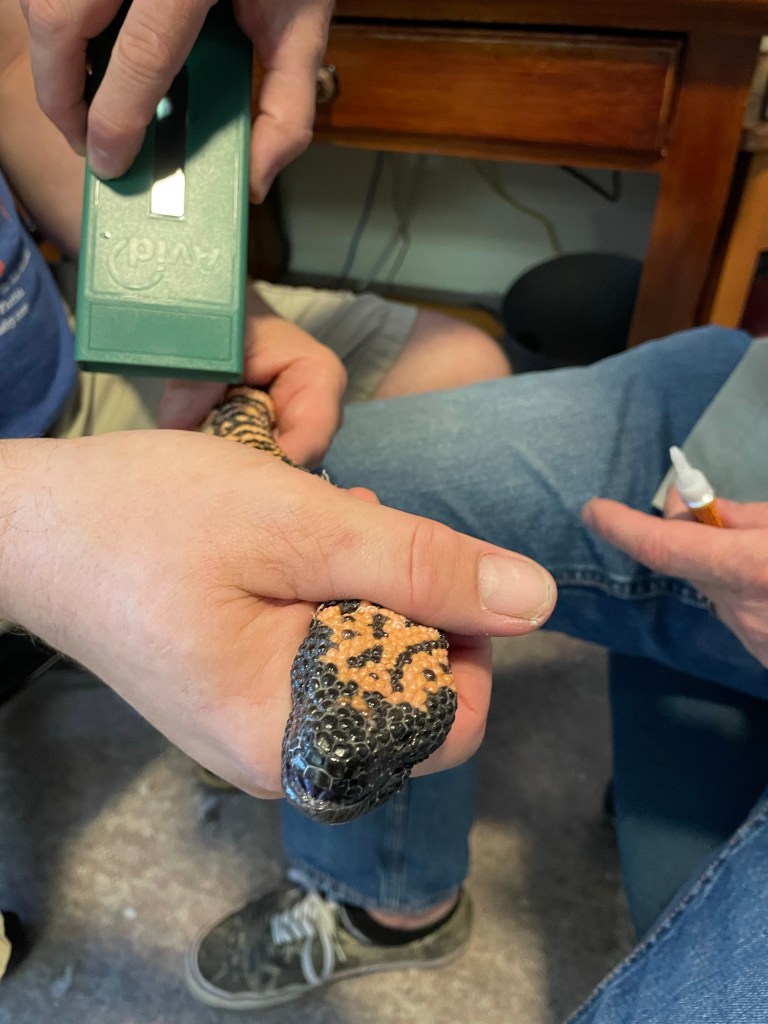
PIT (passive integrated transponder) microchip tags are certainly not new to the pet industry, being used extensively on cats and dogs to help lost animals find their way home. Taking this application a step further, some reptile owners PIT tag their herps to help keep track of animals in their collection or to identify those produced by a certain breeder. Until recently I haven’t given much thought to putting these microchips into my Gilas but a recent incident convinced me otherwise.
Someone on an Internet forum claimed to be selling one of my Gilas, but they didn’t have the “Certificate of Captive Birth“ that I provide with each Gila born here, and the person selling the animal was not registered on my list. I take this very seriously as there are folks selling wild-caught animals as captive-bred using well known breeders names and credentials. After a short investigation, it was found that the Gila was not one of mine but someone was using my name to sell a Gila of unknown origin (I cannot say for sure if it was wild-caught, but the circumstances around this sale were very suspicious). To help verify my Gilas in the future, I decided to look into PIT tagging my lizards.
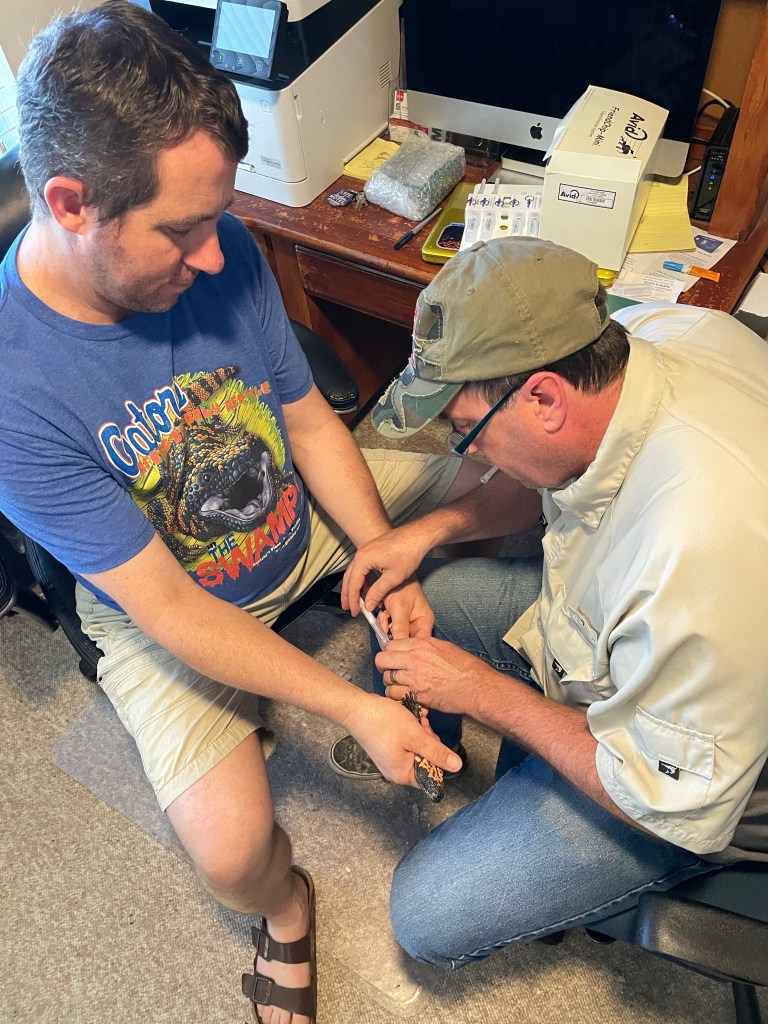
After doing some research and speaking with my friend John who is very knowledgeable in both Gilas and PIT tags, it seemed this would be a good way to go in ensuring my Gilas could be easily identified within my group and to those that purchase from me.
Overall, the procedure is simple and can be done at home with the help of an experienced vet tech or if you are lucky enough to have a good friend knowledgeable in such things (thanks John!), otherwise inquire with your herp vet about the procedure. The health and safety of the animal is always paramount so please don’t take shortcuts on this or any matter concerning your Gilas. I was able to do this at home because I had an experienced friend but would not hesitate to take my Gila monsters to the vet to get the PIT tag installed safely.
After installing the PIT tag, it was checked with a scanner to be sure it didn’t come out. Handling Gilas is always a risky proposition, be sure to put the safety of yourself and those working with you first!
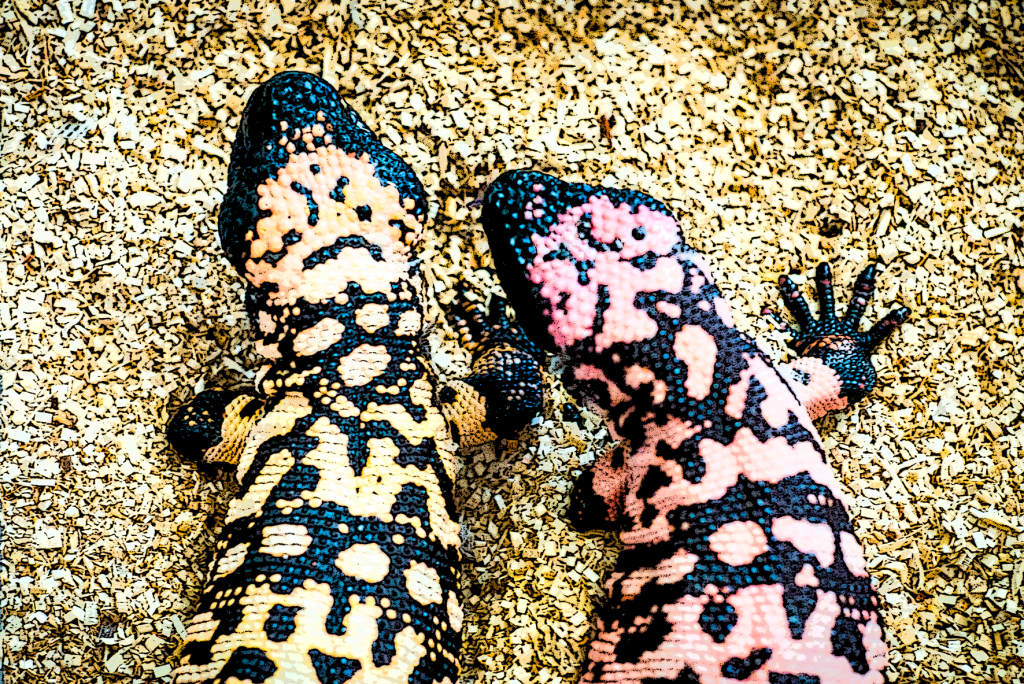
Which one is the boy and which is the girl? Guess first, then answer below.
My 2020 Gila monster season is off and running. After reviewing my data and re-reading my Gila books, I was going to wait until after April 1 this year to pair the Gilas as that is when the magic happened (and seems to be for others as well). With the Shelter-in-Place order in full effect I got bored and but them together last weekend, and guess what? No activity yet. What I have found interesting is that the Gilas seem to remember each other from last year and there was no fighting between the pairs (females bit males for being too pushy). This year they are much more chill, and are spending time together the hide boxes. I have been checking in at night to see what is going on and while both Gilas are active, copulation has not yet been observed. Being a Nervous Nelly, I am concerned that they will not breed this year but will hold my real worry for late April
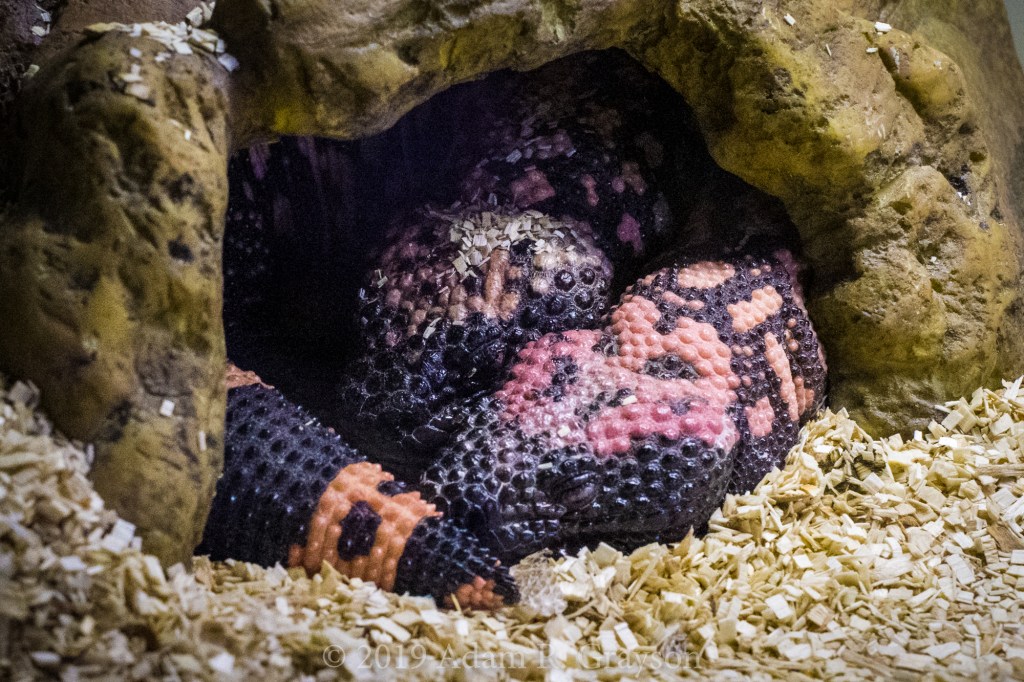
Belle & Pink Floyd (banded Gila monsters) resting sweetly in their hide cave
To me, the real question is could Gila monsters mate for life? I’ve read that in the wild males go back to the same shelters where they have previously copulated and in my observations females certainly do prefer some males over others. The way they rest together and spend time with each other makes this is an interesting avenue to explore. Some breeders swap different females in male cages and have great success, but I am going to try leaving known pairs together to see how things go. I can see why having one pair of Gilas could be difficult to breed and that groups (3.3 or greater) are suggested.
Winston & Heather (reticulated Gila monsters) snooze the day away
As with all things, time will tell. New observations, and hopefully some activity, will be reported here. Stay tuned..

















 Goatsby's Place